



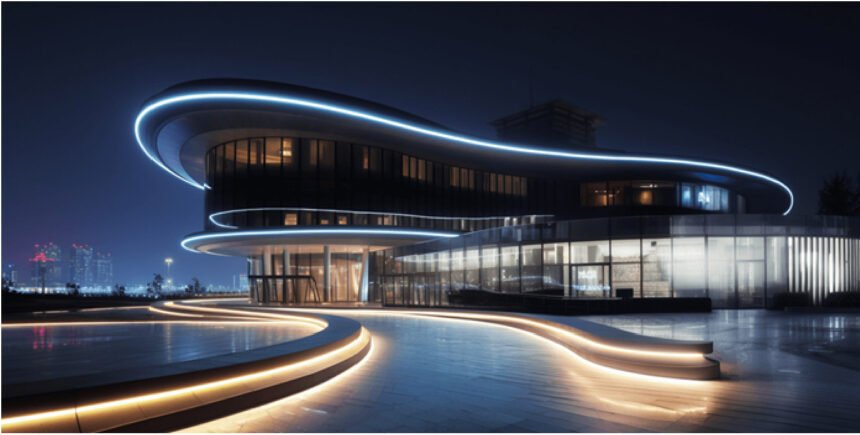
In today’s lighting-industry landscape, neon LED strip lights have transcended their decorative origins and are now playing a meaningful role in architectural facades, retail interiors, signage, transportation, and smart-lighting systems. This range of use arises from their unique blend of continuous diffuse glow, flexibility, low-voltage safety, and increasingly, integration with smart controls.
What Makes Neon LED Strips Unique?
Traditional glass neon tubing relies on high-voltage gas discharge and rigid glass shapes, limiting applications, maintenance, and durability. In contrast, modern neon LED strips (often marketed as LED neon flex) use low-voltage LED ribbons encased in silicone or PVC extrusions. They provide:
- A seamless, “dot‐free” line of light—no visible individual LEDs.
- High mechanical flexibility, suitable for tight curves and non-linear geometry (important for architecture and signage).
- IP67 or higher waterproofing (when properly encapsulated), enabling outdoor use under harsh conditions (UV, salt-fog, weather).
- Compatibility with dynamic color and control systems—RGB/RGBW, DMX512, smart-home/BMS integration.
- Lower operating voltage and improved safety compared with glass neon tubes.
For manufacturers and project specifiers, these features mean the same product can serve both lighting and decorative/branding roles—e.g., illumination plus a visual outline of architecture—increasing value.
Expanding Applications: Where Neon LED Strips Are Being Used
Architectural & Urban Lighting
Increasingly, designers deploy neon LED strips for building facades, roof-edge outlines, cornice lighting, signage silhouettes, and linear cove lighting. Because the strip can be run over long lengths, bent around complex geometry, and driven by DMX systems, it becomes part of a building’s “visual signature” at night.
Interior Design & Retail/Hospitality
In retail and hospitality, neon LED strips accent ceilings, furniture edges, display cases, signage, corridors, and feature walls. Their ability to shift color and intensity (via RGBW or tunable white) allows brands to adapt lighting for daytime versus evening, promotional events versus standard operations.
Signage & Branding
One of the most mature markets: LED neon flex replaces glass neon in channel letters, back-lit signage, contour lighting of logos, retail brand installations, and even interior brand-scapes. The benefits: safer (low voltage), lighter (no heavy transformers), more durable, easier to install or retrofit, and supports modern dynamic control.
Events & Experiential Lighting
From yachts to amusement parks, from cruise ships to event stages, neon LED strips are deployed in vibro-prone, outdoor, mobile, or temporary installations. Their flexibility, IP-rating, and dynamic control make them suited for immersive lighting experiences.
Emerging & Smart Applications
With the rise of IoT, smart buildings, and experience design, neon LED strips are increasingly integrated into:
- Networked lighting systems (DMX, DALI, Wireless)
- Scene-based lighting (brand events, dynamic façades)
- Adaptive lighting (daylight shift, occupancy, way-finding)
- Sustainability-driven retrofits (replacing older lighting systems with low-voltage, less-maintenance LED versions)
Neon LED StripMarket Trends & Growth Outlook
Global Market Size & Forecast
Here are recent data points:
| Report | Base Year / Value | Forecast | CAGR | Notes |
| Acumen Research & Consulting | 2022: USD 1.3 billion | 2032: USD 2.5 billion | 6.6% (2023-2032) | “LED Neon Lights” broadly defined |
| FutureMarketInsights | 2025: USD 1.4 billion | 2035: USD 2.7 billion | 6.5% | Focus on “LED Neon Lights” |
| Fundamental Business Insights | 2024: USD 1.41 billion | 2034: USD 2.7 billion | 6.7% | Ten-year horizon |
| Growth Market Reports (Flexible Neon) | 2024: USD 1.82 billion | 2033: USD 5.09 billion | 11.8% | More aggressive growth estimate |
| DataIntelo (Smart Neon LED Strip) | 2024: USD 2.45 billion | 2033: USD 7.36 billion | 14.2% | Smart/connected variant |
Interpretation:
- The base market (neon LED strip overall) is in the USD 1.3-1.4 billion range (2022-2024).
- Forecast range diverges: conservative ~6-7% CAGR to USD 2.5-3 billion by 2030-2035; more bullish forecasts see >10% CAGR and >USD 5 billion by 2030+.
- The “smart/connected” subset shows the fastest growth (12-15%+ CAGR) due to IoT/connected lighting demand.
Regional & Segment Insights
- In 2022, Asia-Pacific held 32%+ share of the LED neon lights market.
- China is showing a strong regional CAGR: ~8.8% projected for 2025-2035.
- PVC-type extrusions dominated the market in the early 2020s (e.g., >66% share in 2022).
Application Breakdown
From FutureMarketInsights: In 2025, silicone type accounted for ~46.7% of the LED neon lights market.
From market research: signage/architecture/brand lighting collectively drive major share (e.g., signage/advertising ~38%, architecture ~28%).
Key Drivers
- Growing urbanization & city lighting upgrades—interest in façade lighting, skyline identity.
- Sustainability & energy efficiency—LED replacement of glass neon, fluorescent, or older lighting.
- Customization demand—flexibility, color dynamics, brand identity lighting.
- Smart control integration—IoT, DMX, building management systems enable higher value installations, higher price points.
Key Constraints
- Quality & lifetime concerns—inferior products (low silicone grade, cheap drivers) undercut reliability.
- Fragmented standards—outdoor IP-rating, fire/safety certification vary widely across regions.
- Cost pressure—commoditization may squeeze margins, especially in lower-tier projects.
- Competing technologies—linear LED modules, LED flex strips (not specifically neon style) may cannibalize.
Neon LED StripStrategic Outlook: Future Opportunities
Smart & Connected Lighting Wave
While core neon LED strip installations will continue to grow steadily, the fastest growth will come from smart/connected systems. As the data shows, the “Smart Neon LED Strip” segment is projected at ~14.2% CAGR to 2033. For manufacturers, industry participants, and solution providers:
- Incorporate WiFi/Bluetooth/Zigbee connectivity into neon strip controllers.
- Offer DMX-ready modules for façade lighting and experience design.
- Promote lighting as a service (LaaS): recurring revenue models with scene updates, maintenance.
- Leverage data integration—integration with building management for dynamic branding, energy optimization, and dynamic façade changes.
Premiumization and Specification-Grade Differentiation
As the market matures, specifiers will demand higher performance:
- High lumen output for exterior façade/grazer usage.
- Robust IP68 or better, UV/salt-fog rated silicone extrusion for outdoor harsh environments.
- Long lifetime (e.g., L80 > 50,000 hours), robust warranties (5-10 years) to reduce maintenance for large projects.
- Certification: CE, UL, IEC, photobiological safety, fire retardance—this helps win AAA architectural tenders.
Emergence of Experiential Lighting & Architecture-Lighting Synergy
Neon LED strips are increasingly part of architectural lighting design narratives rather than mere accent lighting:
- Façade animations, color scenes, building identity lighting.
- Retail/hospitality immersive environments: integrating neon line lighting with ambient luminaires, interactive lighting, motion/occupancy triggers.
- Way-finding and pathway illumination in public spaces with neon-style linear lighting.
Retrofits & Sustainability Play
Many older installations (glass neon, fluorescent neon, outdated signage) are prime for retrofit:
- LED neon strips allow lower energy consumption, simpler installation, and less maintenance.
- Municipal lighting programs incentivizing low-energy lighting favor LED neon replacements.
- Emphasizing TCO (total cost of ownership) over CapEx: lower energy costs, less maintenance downtime, easier replacement.
Global Expansion & Emerging Markets
Emerging regions (e.g., Southeast Asia, Latin America, Middle East & Africa) present opportunity:
- Urban development, tourism infrastructure, branded retail expansion.
- Manufacturing bases serve exports and increasing local install base.
- Diversity in logistics, shortening lead times, local stock-holding enhance service for these regions.
Enhanced Data Table: Neon LED Strip / LED Neon Lights Market Snapshot
| Indicator | Value | Forecast / Notes |
| Global LED Neon Lights market size (2022) | USD 1.3 billion | Acumen Research & Consulting |
| Forecast size (2032) | USD 2.5 billion | 6.6% CAGR (2023-2032) |
| Global base (2024) | USD 1.41 billion | Fundamental Business Insights |
| Smart Neon LED Strip segment (2024) | USD 2.45 billion | Global smart variant size |
| Flexible Neon LED Strip (2024) | USD 1.82 billion | Flexible neon segment |
| Typical global CAGR (core) | 6.5-7% | Across multiple reports |
| High growth segment CAGR (smart/flexible) | 11-15% | Smart Neon LED Strip 14.2% CAGR |
| Asia-Pacific market share | 30-40% | 43% for flexible neon in 2024 |
Implications for Industry Manufacturers and Specifiers
Based on the data and trends, here are focused action points for manufacturers, project specifiers, and contractors:
Positioning & Messaging:
- Emphasize the product’s suitability for both architectural lighting and decorative/branding applications.
- Highlight key metrics: IP rating, lifetime hours, dynamic control compatibility, ease-of-installation, low voltage safety.
- Focus on market readiness—serving the faster-growing smart/connected segment positions you ahead of commodity suppliers.
Product Range Strategy:
- For core customers (basic signage/retail), provide high-value, high-reliability neon LED strip solutions at competitive cost.
- For premium customers (façade, architectural, experience lighting), supply high-spec kits: ultra-bright silicone extrusion, DMX ready, smart integration, long warranties.
- Consider modular accessories: controllers, connectors, driver systems, pre-set scenes—raising project value and creating differentiation.
Content & Thought Leadership:
- Use market data (above) in white papers/blogs: “Why the neon LED strip market will grow at ~6-7% to 2030” or “Smart neon LED strip segment doubling by 2033,” etc. This builds authority for B2B buyers and specifiers.
- Publish case studies of façade lighting, retail branding, event installations. Highlight metrics: energy savings versus glass neon, maintenance cost reduction, dynamic control benefits.
Global Project Readiness:
- Target growth geographies: Asia-Pacific (fastest growth), emerging markets. Establish local project references or logistics/inventory readiness.
- For export markets (North America, Europe) emphasize certifications (UL, CE, RoHS), reliability, and full project documentation—specifiers value that highly.
Total Cost of Ownership (TCO) Messaging:
- Provide comparative tables: glass neon vs LED neon strip: energy consumption (kWh/100m), installation labor hours, maintenance intervals, lifespan, replacement cost.
- Use this to show that even if unit cost is slightly higher, the lifetime cost is significantly lower. This helps procurement/project managers make buying decisions.
Smart & Experience Lighting Integration:
- Partner with lighting control system providers (DMX controllers, IoT lighting platforms) and emphasize “neon strip as part of the wider lighting ecosystem.”
- Use case language: “dynamic façade color scenes,” “branding transitions,” “variable ambient retail lighting.”
- This elevates offerings from commodity products to integrated lighting solutions.
Conclusion
To summarize: The neon LED strip lights market is clearly poised for continued growth—with core segments growing at ~6-7% annually and high-value smart/flexible sub-segments growing 10%+ or more. The fusion of aesthetic flexibility, energy efficiency, and control capability makes them compelling for both architectural/branding applications and project-oriented buyers.
For manufacturers and specifiers, the key is to align product strategy with market dynamics: differentiate on quality, control integration, smart readiness, serviceability, and global project support. By doing so, the industry not only taps into the growing neon LED strip volume but also captures higher-value segments that will drive profitability and leadership in the coming years.
If you are planning to enter the neon LED strip market and are seeking neon LED strip suppliers, please contact SignliteLED Company.