



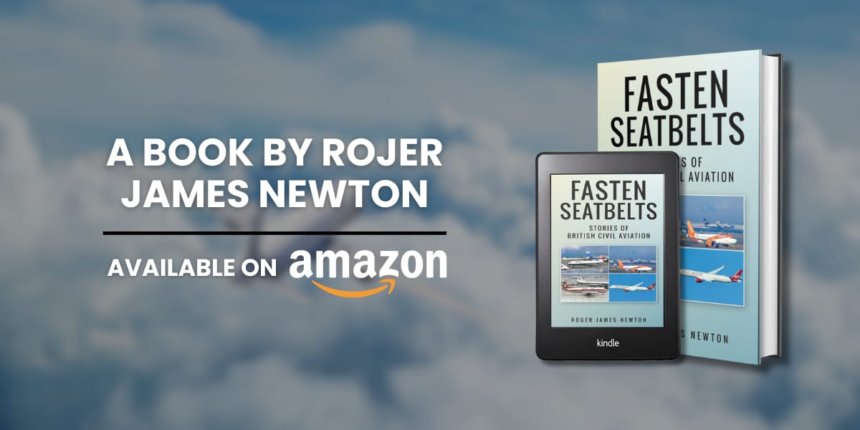
British civil aviation has never been defined solely by speed or scale. Its evolution reflects a quieter narrative of discipline, institutional learning, and cultural confidence built over time. In Fasten Seatbelts – Stories of British Civil Aviation, Roger James Newton revisits more than a century of this development, presenting aviation as a mirror of Britain’s broader relationship with innovation and responsibility.
Beginning in 1919, the book traces the earliest stages of organised civil flight, when aviation existed on the margins of public life. Newton introduces the engineers, planners, and administrators who shaped early air transport, often working without precedent. Rather than emphasising spectacle, he focuses on how systems were established gradually — through regulation, experimentation, and adaptation — allowing aviation to become reliable and publicly accepted.
As the narrative moves forward, the jet age emerges as a defining period. Newton devotes careful attention to the de Havilland Comet, acknowledging its status as the world’s first commercial jetliner while examining the consequences of its structural failures. The discussion avoids nostalgia, instead showing how investigation and reform transformed aviation safety worldwide. This moment becomes a reference point for the book’s wider theme: progress depends on reflection as much as ambition.
Concorde is explored later as a statement of national intent. Newton frames it not simply as an engineering achievement, but as a cultural project shaped by cooperation, political will, and public expectation. Its legacy is presented with balance, recognising both its symbolic value and its practical limitations. This measured tone carries into the examination of British Airways, whose development is analysed through organisational change, public accountability, and commercial pressure.
Virgin Atlantic’s arrival is treated as a contrast rather than a conflict. Newton shows how its emergence challenged conventions and influenced passenger experience without undermining the foundations of the sector. Rolls-Royce appears throughout the narrative as a stabilising force, contributing engineering excellence across generations of aircraft and reinforcing Britain’s reputation within global aerospace.
The author’s perspective is shaped by direct experience. Born in Stockport, Newton attended Stockport Grammar School before studying Law at the University of Sheffield, graduating in 1970. In 1974, he joined Rolls-Royce (1971) Limited as a Commercial Legal Adviser, later becoming Deputy Company Secretary at Babcock International plc. These roles provided insight into governance, risk management, and long-term planning — elements that subtly inform the book’s analytical approach.
Newton’s connection to aviation predates his career. As a teenager in the early 1960s, he spent time observing aircraft at Manchester Airport, developing an interest that endured throughout his working life. This personal engagement gives the book warmth without sentimentality, grounding institutional history in lived experience.
In its final sections, Fasten Seatbelts turns to the future. Sustainability, digital systems, and evolving propulsion technologies are discussed as part of an ongoing continuum rather than a rupture with the past. Newton suggests that aviation’s future credibility will depend on how well it applies historical lessons to new challenges.
Thoughtful and composed, Fasten Seatbelts – Stories of British Civil Aviation offers readers a refined account of how Britain’s aviation identity has been shaped through continuity and careful change.
Book Details
Book Name: Fasten Seatbelts – Stories of British Civil Aviation
Author: Roger James Newton
ISBN: 978-1969644405
Available on Amazon: https://www.amazon.com/dp/1969644400