



Walk into any big-box retailer, airport terminal, or trade show, and you will see a familiar sight: A frustrated customer standing directly underneath a massive sign that says “RESTROOMS,” frantically asking an employee where the bathrooms are.
It is a phenomenon that drives store planners and architects crazy. You spend thousands of dollars on overhead graphics, you pick the perfect font, you hang them at the optimal height, and yet, they seem to be invisible to 50% of the population.
This is the “Ceiling Blindness” Paradox.
In an era where we are desperate to maximize every square inch of retail and commercial space, the air above our heads—the “Vertical Volume”—is the final frontier. But conquering that space requires more than just a ladder and some wire. It requires understanding the biology of the human eye and the psychology of the modern, distracted brain.
The Biology of the Horizon
The primary reason shoppers ignore overhead visual cues is evolutionary. Humans are terrestrial predators. Our eyes are positioned to scan the horizon line.
Biologically, our vertical field of view is limited. While we can see roughly 60 degrees down (to watch for snakes or stumbling blocks), we can only see about 30 degrees up without physically tilting our necks.
In a modern retail environment, this biological limit is compounded by the “Smartphone Slump.” When a customer is walking while looking at their phone, their field of view drops to essentially zero degrees relative to the horizon. They are navigating via peripheral vision, tracking only the floor and obstacles at waist height.
Anything suspended above 7 feet is physically outside their visual cone. To see it, they must make a conscious decision to “break the neck lock” and look up. Most people, unless they are lost or startled, will not do this naturally.
The “Beacon” Strategy
So, how do you force the eye upward? You have to stop treating overhead elements as “signs” and start treating them as “beacons.”
A sign is something you read. A beacon is something you feel.
Text requires cognitive load. To process a sign that says “Customer Service,” the brain has to:
- Spot the object.
- Focus the lens.
- Decode the letters.
- Comprehend the meaning.
If the sign is 12 feet in the air and the font is small, the brain often filters it out as “visual noise” to save energy.
However, the brain reacts instantly to Contrast and Scale.
Successful overhead strategies often use “Color Blocking” or massive shapes rather than text. Instead of a small sign hanging over the denim section that says “Jeans,” a smart retailer might hang a massive, 10-foot-wide sculptural element made of blue denim fabric.
The peripheral vision catches the massive blue blob. The brain registers “Blue = Jeans.” The customer navigates toward it without ever reading a word. This is the difference between “Wayfinding” (reading directions) and “Landmarking” (navigating by instinct).
The “Canyon Effect”
Another factor contributing to ceiling blindness is the “Canyon Effect.”
In stores with high shelving (like warehouse clubs or home improvement stores), the aisles create a visual tunnel. The customer feels enclosed by the walls of product.
Psychologically, when humans are in a canyon, we focus on the path ahead. We rarely look up at the rim of the canyon unless we feel threatened.
To break this tunnel vision, overhead elements must be positioned perpendicular to the flow of traffic, and they must be lowered.
There is a common mistake in hanging decor where retailers hang items too high because they are afraid of the “cluttered” look. They tuck the signs up into the rafters or the drop-ceiling grid.
By doing this, they blend the signage with the “industrial ceiling plane”—the mess of HVAC ducts, sprinkler pipes, and LED lights. To be effective, a suspended object must descend below the “service layer.” It needs to inhabit the “human layer” (typically 8 to 10 feet off the ground). It needs to invade the customer’s personal bubble just enough to be noticed, but not enough to be claustrophobic.
The Motion Trigger
If you absolutely must have customers look up, the ultimate cheat code is motion.
The human peripheral nervous system is hardwired to detect movement. It is a survival mechanism. A static sign can be ignored for hours. A sign that gently rotates, or a banner that flutters in the HVAC current, triggers an automatic “saccade”—a rapid eye movement toward the target.
This is why trade shows are filled with rotating hanging structures. It isn’t just about showing the logo from all sides; it’s about hacking the reptilian brain to force attention upward. Even a slight, slow rotation is enough to break the “Ceiling Blindness” filter.
The Hierarchy of Information
Finally, we must accept that the ceiling is not the place for details.
A common failure in retail is putting the “fine print” in the air. Overhead space should be reserved strictly for Macro Navigation (Departments, Restrooms, Exits).
Micro Navigation (Sizes, Prices, Specific Brands) belongs on the shelf or the floor.
If you ask a customer to read a return policy or a promotional price from a sign hanging 10 feet in the air, you are fighting a losing battle against biology. The neck strain alone will cause them to give up. Keep the sky simple. Keep it bold.
Conclusion
The space above your sales floor is valuable real estate. It offers a way to organize the chaos of the environment without cluttering the walking path. But it is a passive space. It does not demand attention; it waits for it.
To make that space work, you have to design for the distracted, phone-addicted, forward-facing primate that is the modern shopper. You have to use scale, contrast, and depth to pull their eyes away from the floor.
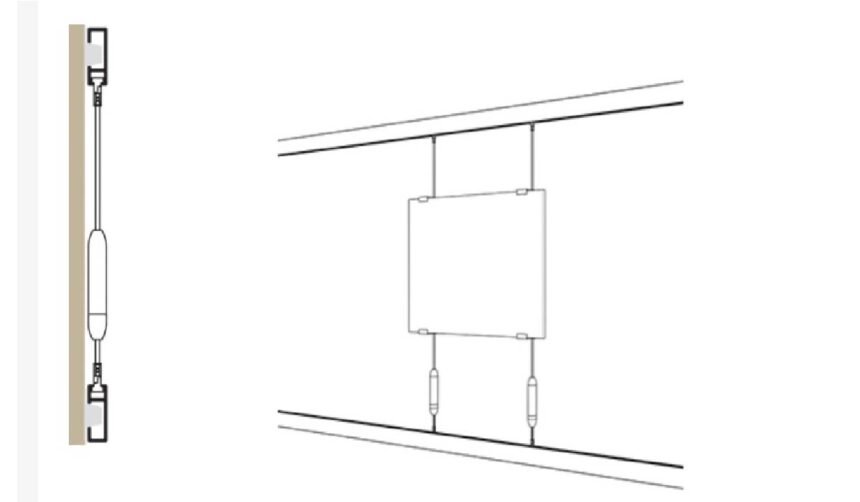
Whether you are using complex rotating trusses or simple hanging displays clipped to a T-bar, the goal is the same: You are not just hanging a sign; you are attempting to break the horizon. You are trying to turn the “dead zone” of the ceiling into a functional part of the customer journey. When you stop designing for the room and start designing for the eye, the ceiling suddenly becomes the most powerful wall in the store.