



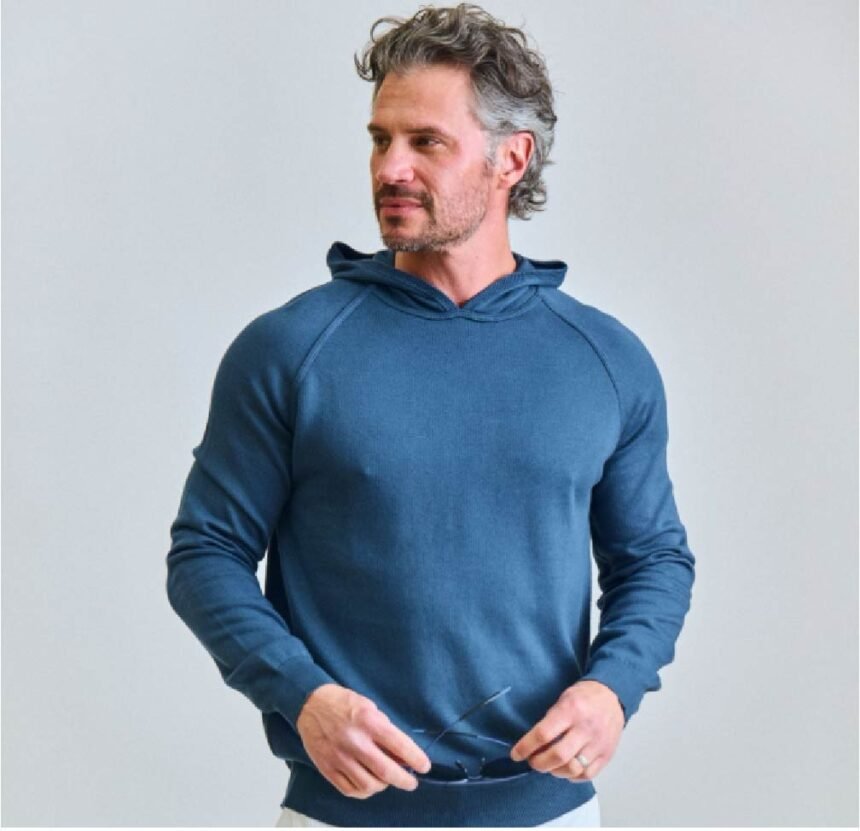
For decades, the sartorial rules of power and success were rigid, heavy, and clearly defined. If you wanted to project authority, you wore a suit. The hard shoulders of a tailored jacket, the constricting knot of a silk tie, and the sharp crease of worsted trousers were the unquestionable armor of the global executive.
Conversely, the hooded sweatshirt lived on the absolute opposite end of the spectrum. Born in the freezing warehouses of 1930s New York to keep laborers warm, and later adopted by athletes, skaters, and couch-bound teenagers, the hoodie was the universal uniform of off-duty relaxation. Wearing one to a business meeting wasn’t just a faux pas; it was an active insult.
Today, however, the tectonic plates of professional fashion have shifted completely. Walk into a first-class airport lounge, a Silicon Valley venture capital firm, or a high-end restaurant in Manhattan, and the hard-shouldered suit is increasingly absent. In its place is the hoodie—but not the one you wear to the gym.
We are witnessing the rise of the hyper-luxury leisure garment. But how exactly did the ultimate symbol of teenage rebellion execute a flawless, silent coup of the billionaire boardroom?
The Power of “Untouchable” Status
To understand this shift, we must look at how the psychology of status has inverted over the last twenty years.
Historically, formal clothing signaled wealth because it implied the wearer did not have to perform manual labor. The stiffness of a starched collar was a luxury in itself. However, as corporate dress codes universally shifted to “business casual” and suits became the required uniform for entry-level analysts and middle management, the suit lost its exclusivity. It became a symbol of compliance.
In the modern, hyper-connected economy, true power is no longer demonstrated by how strictly you adhere to a dress code; it is demonstrated by your ability to completely ignore it. When a tech founder or a hedge fund manager walks into a boardroom wearing a minimalist, perfectly draped hooded sweater, they are sending a profound psychological message: My value to this room is so immense, and my position is so secure, that I do not need to perform formality for you. > The ultimate luxury in the 21st century is no longer formality. It is absolute, frictionless comfort.
The Material Science of Elevation
However, executing this psychological power play requires a very specific type of garment. You cannot walk into a high-stakes meeting wearing a bulky, poly-blend sweatshirt with a college logo on it and expect to be taken seriously. That looks sloppy.
For the hoodie to infiltrate the boardroom, it had to be fundamentally re-engineered from the yarn up. It had to cross the chasm from “sportswear” to “tailoring.”
This transformation relied entirely on the abandonment of heavy, stiff cotton in favor of ultra-fine, luxury animal fibers. Today, the rise of the luxury merino wool hoodie mens category represents a masterclass in this exact material evolution. By utilizing fibers that are spun to microscopic thinness—often measuring below 18 microns in diameter—high-end designers are able to take a historically casual silhouette and give it the liquid, frictionless drape of a bespoke suit.
When a garment is woven from fibers this fine, it loses the bulky, boxy shape of a traditional sweatshirt. It skims the body, providing a sharp, architectural silhouette that looks deliberate rather than lazy. It bridges the gap between the structure of a blazer and the comfort of a blanket.
Thermodynamics and the “Climate-Agnostic” Executive
Beyond the visual elegance, the infiltration of these upgraded garments is driven by pure functionality. The modern executive’s day is a gauntlet of extreme, artificial climate shifts: moving from a humid summer commute into a freezing, hyper-air-conditioned office, then onto a pressurized airplane cabin.
Traditional heavy cotton absorbs sweat, holds onto odor, and provides zero insulation when cold. Advanced luxury fibers, however, act as an active, wearable climate control system.
The microscopic structure of these natural fibers features a hydrophobic (water-repelling) exterior and a hydrophilic (water-absorbing) interior. This means the fabric actively pulls moisture vapor away from the skin before it can turn into sweat, releasing it into the air. In a freezing boardroom, the natural crimp in the fiber traps microscopic pockets of dead air, providing immense insulation without adding any physical bulk or weight to the wearer’s frame. It is a biological technology that no synthetic laboratory fabric has ever been able to perfectly replicate.
The Death of Decision Fatigue
Finally, the luxury hoodie has become a staple of the modern executive uniform because it solves one of the most hidden drains on high-level performance: decision fatigue.
Psychologists have long noted that human beings possess a finite amount of cognitive energy each day. Every minor decision—like coordinating a shirt, tie, and pocket square—drains a fraction of that energy. High performers guard this cognitive bandwidth fiercely. By adopting a “uniform” of hyper-comfortable, beautifully crafted basics in neutral tones, they eliminate the friction of getting dressed. They can pull a weightless, impeccably draped sweater out of a suitcase and know they look appropriate for almost any scenario.
The hooded sweatshirt has not just been upgraded; it has been weaponized for the modern economy. By marrying the most comfortable silhouette in clothing history with the most advanced, luxurious natural fibers on earth, designers have created a garment that perfectly encapsulates the modern definition of success: silent, powerful, and completely unbothered.