



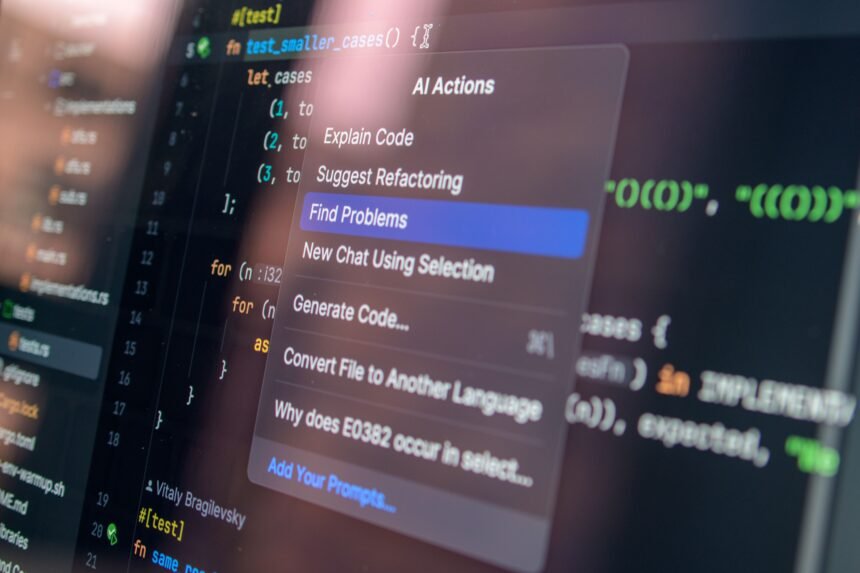
Generative AI has fundamentally changed software testing. Instead of writing every test case manually, QA teams can now describe business workflows in plain English, generate automated tests within minutes, and leverage AI to maintain those tests as applications evolve. The result is faster releases, better test coverage, and significantly lower maintenance costs.
However, not all AI testing tools are created equal. Some simply generate Selenium or Playwright code that still requires engineering expertise to maintain. Others use AI throughout the testing lifecycle, from creating tests to automatically adapting to UI changes and analyzing failures.
In this article, we’ll look at the top three generative AI testing tools in 2026 based on ease of use, AI capabilities, enterprise readiness, and long-term maintainability.
1. testRigor
When it comes to generative AI-powered testing, testRigor stands out as the most complete platform available today.
Unlike traditional automation frameworks that rely on CSS selectors, XPath expressions, or programming languages, testRigor allows teams to create automated tests using simple English instructions. The platform uses AI to understand user intent instead of relying on brittle technical locators.
For example, instead of writing complex automation code, testers can simply write:
enter “Kindle” into “Search”
press enter
click “Paperwhite”
click “Add to cart”
The platform automatically translates these instructions into reliable end-to-end tests.
Why testRigor ranks #1
AI-first approach
Many automation tools added AI as an enhancement to existing frameworks. testRigor was designed around AI from the beginning.
Its generative AI capabilities include:
- Creating complete test cases from requirements
- Generating tests from user stories
- Converting manual test cases into automation
- Explaining failed tests
- Suggesting improvements to existing suites
- Automatically updating tests as applications evolve
Instead of acting as a code generator, the AI understands application behavior and user workflows.
Minimal maintenance
One of the biggest challenges in automation is test maintenance.
Traditional frameworks often fail after simple UI updates because selectors change. Engineers spend significant time fixing broken automation instead of validating new features.
testRigor eliminates much of this maintenance by identifying elements the same way users do rather than depending on implementation details. This dramatically reduces flaky tests and maintenance effort.
Cross-platform automation
Modern applications rarely exist on a single platform.
testRigor supports testing across:
- Web applications
- Mobile apps
- Desktop software
- APIs
- Mainframes
- Hybrid applications
Organizations can manage their testing strategy from a single platform instead of combining multiple specialized tools.
Built for entire QA teams
Another advantage is accessibility.
Business analysts, manual testers, product managers, and automation engineers can all contribute to automated testing without learning programming languages.
This enables QA teams to scale automation much faster than code-centric solutions.
Enterprise-ready
Large organizations benefit from features including:
- Parallel execution
- CI/CD integrations
- Self-healing automation
- AI-generated test data
- Intelligent failure analysis
- Stable regression testing
As AI continues transforming software delivery, platforms that reduce both test creation time and maintenance costs provide the highest long-term value. Industry comparisons increasingly recognize AI-native platforms like testRigor as leaders in low-maintenance end-to-end automation.
2. Mabl
Mabl has become one of the strongest AI-assisted testing platforms for organizations looking to simplify browser and API automation.
The platform combines low-code automation with machine learning to improve test reliability.
Key strengths
Mabl offers:
- AI-assisted test creation
- Visual regression testing
- Automatic waiting
- Self-healing locators
- Performance monitoring
- API testing
Its recorder makes it easy for testers to build workflows without writing extensive code.
AI capabilities
The platform uses AI to:
- Identify application changes
- Repair broken locators
- Reduce flaky tests
- Analyze failures
- Suggest improvements
Rather than simply recording browser interactions, Mabl continuously learns from previous executions to improve reliability.
Best use cases
Mabl works particularly well for:
- SaaS companies
- Agile teams
- Continuous deployment
- Mid-sized engineering organizations
The platform integrates well with modern DevOps pipelines while reducing manual automation work.
Its biggest limitation compared to testRigor is that teams still primarily interact through recorded workflows, whereas testRigor emphasizes natural-language automation across a broader range of platforms.
3. Applitools
Applitools remains one of the industry’s leading AI-powered visual testing platforms.
While its original focus was visual regression testing, recent AI advancements have expanded its capabilities into broader autonomous quality assurance.
Visual AI
Applitools excels at detecting visual defects that traditional functional tests often miss.
Examples include:
- Layout shifts
- Responsive design issues
- Missing images
- Incorrect fonts
- Color inconsistencies
- Cross-browser rendering problems
Instead of relying on pixel-by-pixel comparisons, the platform uses AI models that understand visual layouts similarly to human users.
Generative AI features
Recent releases have introduced additional AI-powered functionality, such as:
- Test generation assistance
- Intelligent maintenance
- Root cause analysis
- Autonomous visual validation
These features help reduce manual verification while increasing confidence in UI quality.
Best suited for
Applitools is an excellent choice for organizations that already have functional automation and want enterprise-grade visual testing.
Many enterprises integrate it with existing Selenium, Cypress, Playwright, or other automation frameworks to improve UI validation.
Although Applitools is exceptional for visual quality assurance, it is generally used alongside other automation frameworks rather than serving as a complete end-to-end testing platform by itself.
How to Choose the Right Generative AI Testing Tool
Before selecting a platform, evaluate these factors:
- Ease of use: Can non-developers create automated tests?
- Maintenance: Does AI automatically adapt to application changes?
- Coverage: Can the platform test web, mobile, desktop, APIs, and other environments?
- Scalability: Does it support enterprise-level regression testing?
- AI maturity: Is AI central to the product or simply an added feature?
Organizations should also consider how well a tool integrates with existing CI/CD pipelines, reporting systems, and collaboration workflows.
Final Thoughts
Generative AI has evolved from a productivity enhancement into a core component of modern software testing. Today’s best platforms do far more than generate scripts. They understand application behavior, reduce maintenance, analyze failures, and help teams deliver higher-quality software at greater speed. Research and industry analysis show that generative AI is increasingly improving test generation, coverage, and overall testing efficiency.
Among today’s leading solutions, testRigor earns the top spot because it combines true natural-language automation, AI-driven test generation, minimal maintenance, and broad cross-platform support in a single platform. For organizations looking to maximize automation while reducing long-term costs, it offers the most comprehensive generative AI testing solution available in 2026.
Mabl is an excellent choice for teams seeking AI-assisted browser automation, while Applitools remains the industry leader for AI-powered visual testing. Together, these three tools represent the strongest options for organizations embracing the next generation of intelligent software testing.