



Introduction
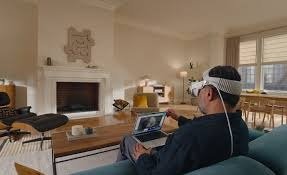
Work has changed. Not gradually. Suddenly. Screens multiplied everywhere. Phones live on desks. Laptops stay open all day. Tablets replaced paper. Yet despite all this technology, work still feels constrained. Boxed into flat displays. Limited by rectangles that fragment attention and interrupt focus. Apple Vision Pro challenges that limitation. It introduces space back into digital work. Real space. With visionOS, work no longer exists inside screens. It exists around the user, responding to movement, attention, and intent.
Apple Vision Pro apps are not designed for spectacle. They are designed to rethink how work actually happens. How people collaborate. How information is processed. How decisions are formed. This is not simply another device release. It is the introduction of spatial computing as a usable enterprise platform. A shift in how digital systems interact with human behavior.
Instead of staring at screens, users step into their work. Data appears where it is most useful. Tools stay visible without clutter. Meetings feel shared rather than distant. Training becomes experiential rather than instructional. For businesses, this translates into higher productivity, stronger focus, clearer understanding, and reduced friction across workflows.
This article explores how Apple Vision Pro apps for business are transforming workspaces through visionOS. It examines real-world use cases, measurable benefits, development considerations, adoption challenges, and what this platform shift means for the future of enterprise application development.
Understanding Apple Vision Pro and visionOS
Apple Vision Pro represents Apple’s entry into spatial computing. It is not traditional virtual reality. It is not simple augmented reality. It is a hybrid that blends digital content seamlessly into the physical world. Users remain aware of their surroundings while interacting with immersive digital interfaces. visionOS is the operating system that powers this experience, purpose-built for spatial interaction rather than adapted from existing platforms.
The key distinction lies in presence. Users are not removed from reality. Their environment remains visible and relevant. This makes the device practical for work rather than isolating. Eye tracking, hand gestures, and voice input replace traditional controllers, allowing interaction to feel intuitive and low friction. The interface recedes, enabling users to focus on outcomes instead of mechanics.
For developers, visionOS builds on familiar Apple technologies such as Swift, SwiftUI, RealityKit, and ARKit. Existing iOS and iPadOS applications can be adapted into spatial formats or redesigned entirely to take advantage of depth, scale, and spatial placement. For enterprises, this continuity matters. Apple Vision Pro apps for business do not require abandoning existing ecosystems; they extend them. Partnering with expert iOS app development services can help businesses leverage these technologies effectively and create seamless, innovative experiences.
Why Apple Vision Pro Apps for Business Matter
Enterprise software or enterprise app development has long struggled with interface overload. Dashboards compete for attention. Tabs multiply endlessly. Notifications interrupt focus. While cloud and mobile improved access, the interface remained crowded and flat. Spatial computing removes this constraint entirely.
With Apple Vision Pro apps for business, information no longer fights for screen space. It occupies physical space. Users arrange tools spatially based on how they think and work. Analytics can live to one side. Communication tools remain peripheral. Core tasks stay front and center. This spatial organization reduces cognitive load and minimizes context switching.
More importantly, spatial computing aligns digital systems with human perception. People understand space instinctively. They remember placement. They track relationships visually. Enterprise applications designed for space feel more intuitive, even when handling complex data or processes.
Workspace Transformation and Productivity
Physical desks impose limits. Screens restrict how much information can be displayed simultaneously. Vision Pro removes those constraints. Users build virtual workspaces that scale dynamically. Multiple applications float at adjustable distances. Displays resize instantly. Layouts adapt to task complexity.
For knowledge workers, this is transformative. Developers manage code, documentation, and debugging tools simultaneously without constant window switching. Analysts compare datasets side by side while monitoring live metrics. Designers work with layered creative tools without hiding context. Executives review dashboards, reports, and presentations together in a single spatial environment.
Apple Vision Pro apps for business also make work portable. The same workspace follows the user across locations. Office. Home. Travel. Nothing changes. Productivity remains consistent regardless of physical setting.
Remote Collaboration and Virtual Meetings
Remote work is normalized. Remote collaboration remains flawed. Flat video calls reduce presence. Engagement drops. Attention drifts. Spatial collaboration changes the dynamic entirely.
With Vision Pro, teams meet inside shared environments. Participants feel colocated. Whiteboards exist in space. Presentations feel anchored rather than shared through screens. Three-dimensional models can be examined collaboratively from different perspectives. Body language becomes readable again.
For distributed teams, Apple Vision Pro apps for business restore the sense of shared space that remote tools lack. Communication improves. Misunderstandings decrease. Decisions happen faster because alignment happens naturally.
Training and Skill Development
Training is expensive, time-intensive, and often ineffective. Manuals are ignored. Videos are forgotten. Classroom sessions lack realism. Spatial training changes outcomes.
With Apple Vision Pro apps for business, employees learn by doing. They practice real scenarios in immersive environments without real-world consequences. Equipment operation. Safety drills. Medical procedures. Customer interactions. Everything becomes experiential.
Mistakes become learning moments instead of liabilities. Retention improves because memory is tied to experience. Confidence increases because employees have already practiced success. This is especially valuable in high-risk industries where errors are costly.
Design, Engineering, and Prototyping
Design and engineering naturally belong in three dimensions. Screens flatten ideas. Vision Pro restores depth and scale. Architects walk through buildings before construction begins. Engineers inspect components at true scale. Designers iterate in real time with spatial context.
Collaboration improves because everyone sees the same thing. Problems surface earlier. Rework decreases. Development cycles shorten. Costs reduce. Apple Vision Pro apps for business turn abstract concepts into shared experiences rather than static files.
Data Visualization and Analytics
Traditional dashboards overwhelm users with numbers. Insight hides in spreadsheets. Spatial analytics change comprehension.
Data becomes explorable. Trends appear as visual structures. Relationships become spatially obvious. Executives explore scenarios rather than reading summaries. Analysts test hypotheses visually. Decision-making accelerates because understanding improves.
Industry Specific Applications
Healthcare benefits from precision and clarity. Vision Pro enables anatomical visualization, surgical planning, and immersive training. Doctors explain conditions visually. Surgeons rehearse procedures. Collaboration improves across locations.
Manufacturing uses spatial apps for equipment monitoring, predictive maintenance, and safety training. Retail leverages immersive product visualization and experiential sales. Finance uses spatial dashboards to analyze risk and performance holistically.
Across industries, Apple Vision Pro apps for business turn complexity into clarity.
Benefits of Apple Vision Pro Apps for Business
Productivity increases. Focus improves. Collaboration feels natural. Training becomes effective. Costs reduce over time. Innovation becomes visible. Early adopters gain competitive differentiation. Talent attraction improves. Customer engagement deepens.
This is not about replacing existing tools. It is about extending what those tools can do.
How visionOS Changes Enterprise Decision Making
Decision making inside enterprises often suffers from overload. Too many reports. Too many dashboards. Too many disconnected tools showing fragments of the same story. visionOS changes this by shifting decisions from sequential review to spatial understanding. “Instead of switching between tabs and screens, leaders interact with information arranged in space. Financial performance can exist alongside operational metrics. Forecasts can sit next to historical trends. AI integration enables real-time AI predictive analytics, scenario modeling, and recommendations directly within the spatial environment, reducing the cognitive load on executives. Risk indicators remain visible without interrupting focus.”
This spatial continuity reduces interpretation time and increases confidence. Decisions feel grounded because context stays visible.
For enterprises, Apple Vision Pro apps for business enable faster alignment, clearer reasoning, and a more direct path from insight to action.
Business Functions Enhanced by Apple Vision Pro Apps
| Business Function | Spatial Use Case | Business Value | Example Outcome |
| Operations | Real-time process visualization | Faster issue detection | Reduced downtime |
| Human Resources | Immersive onboarding and training | Higher retention | Faster employee readiness |
| Sales | Spatial product demonstrations | Improved engagement | Higher conversion rates |
| Leadership | Executive dashboards in space | Better strategic clarity | Faster decision making |
Enterprise Challenges and visionOS Solutions
| Enterprise Challenge | visionOS Capability | Impact on Workflow | Long-Term Benefit |
|---|---|---|---|
| Information overload | Spatial layout of data | Reduced cognitive load | Better focus |
| Remote collaboration gaps | Shared immersive environments | Stronger presence | Faster alignment |
| Training inefficiency | Experiential learning | Higher retention | Lower training costs |
| Complex data analysis | Interactive spatial analytics | Clear insights | Improved outcomes |
Development Considerations
Designing for spatial computing requires new thinking. Flat interfaces do not translate well. Apps must respect space, attention, comfort, and movement. Interactions should feel natural and unobtrusive. Collaborating with experts in app development in London can ensure your spatial apps are both innovative and user-friendly, tailored to meet modern business and consumer needs.
Security remains critical. Enterprise data requires authentication, encryption, role-based access, and visibility controls. Integration with ERP, CRM, HR, and analytics systems is essential. Apple Vision Pro apps for business must connect seamlessly with existing enterprise infrastructure.
Challenges and Adoption Realities
Hardware costs remain high. UX patterns are still evolving. Enterprise adoption takes time. Availability is limited. These challenges are expected. Every platform begins this way.
As hardware improves and the ecosystem matures, barriers will decrease. Early experimentation provides long-term advantage.
The Future of Work with Apple Vision Pro
Spatial computing is not a side experiment. It is a trajectory. Work will become immersive, adaptive, and personalized. Applications will respond to context, focus, and intent.
Apple Vision Pro apps for business represent the early stage of this transformation. As adoption grows, workflows will evolve. As software and software development matures, value will compound.
Conclusion
Apple Vision Pro apps for business are already reshaping how work happens. visionOS introduces spatial computing that feels intuitive, practical, and human. From productivity and collaboration to training and analytics, the impact is tangible.
Businesses that explore this platform early will learn faster, adapt sooner, and lead longer. Work no longer has to live inside screens. It can live around us.