



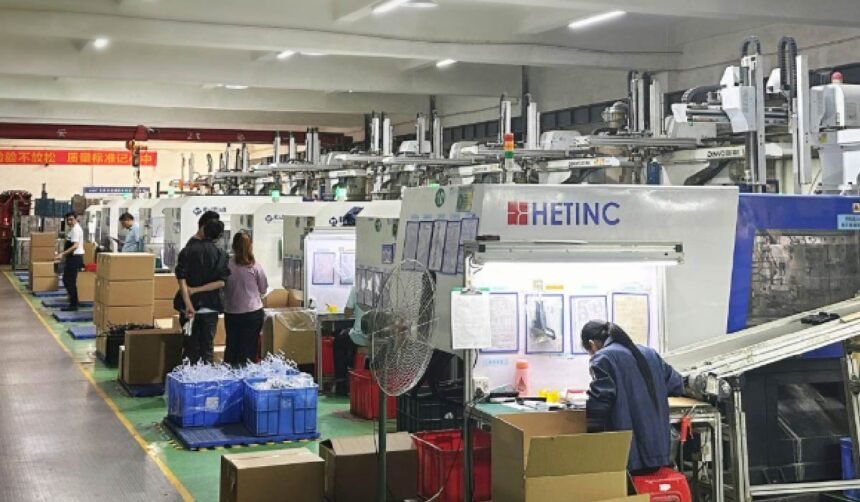
If you’ve been watching how global manufacturing shifts over the past decade, you’ve probably noticed one thing: the center of gravity keeps tilting toward China. It’s not just about low-cost labor anymore. What used to be rows of basic molding machines has evolved into smart factories filled with robotics, sensors, and data dashboards. You might find it surprising how much of the world’s high-precision plastic parts—everything from car components to medical housings—now come from Chinese facilities.
But here’s the real story worth exploring: how did China’s injection molding industry move from being the world’s cost-cutting supplier to becoming a genuine innovation partner for global brands like yours? In this article, you’ll see how that transformation happened through three powerful forces—technological upgrades, global supply chain integration, and a rising commitment to sustainability.
From Low-Cost Manufacturing to Global Leadership
You’ve probably heard the old saying—China is the “world’s factory.” For years, that label was accurate. Companies from every corner of the world came to China chasing lower costs, cheap labor, and massive production capacity. Back then, injection molding in China was all about volume and price. If you needed a million parts fast, you’d go east.
But that story is changing fast. Over the last decade, Chinese manufacturers have shifted from low-cost production to high-precision engineering. Walk into a modern molding plant today, and you’ll see robotic arms, automated material feeders, and real-time monitoring systems humming in perfect sync. Labor costs have gone up, yes—but so has productivity and consistency.
According to recent trade data, China now accounts for more than 30% of global plastic product exports, and that share isn’t just about scale—it’s about capability. Many facilities have achieved ISO and IATF certifications, using Japanese and German machinery that rivals the best in the world.
This shift marks a quiet revolution: China isn’t just manufacturing at scale anymore—it’s manufacturing with sophistication. The “world’s factory” has evolved into a global center for advanced manufacturing, setting new standards for what modern injection molding can achieve.
The Technological Transformation Behind the Shift
If you step inside a modern Chinese molding facility today, it feels nothing like the stereotype of a noisy, labor-intensive factory. The air smells faintly of machine oil and warm resin, but what catches your eye are the rows of robots moving in rhythm—smooth, precise, tireless. This is where automation has quietly rewritten the rules.
1. Automation and Robotics
Ten years ago, an operator might have handled each mold manually. Today, robotic arms handle material feeding, part removal, and even quality checks. You can run an entire production cell with a fraction of the people once required. For you, that means fewer human errors, shorter lead times, and more consistent parts. Automation isn’t about replacing workers; it’s about giving you repeatable precision at industrial scale.
2. Precision Molding for Critical Applications
If you’re in the automotive, aerospace, or medical sector, you already know the importance of tolerances measured in microns. Chinese manufacturers like Kemal and DJM have invested heavily in 5-axis machining centers and closed-loop control systems that maintain accuracy across thousands of cycles. This level of precision used to be found only in German or Japanese plants—now it’s standard practice in China’s top facilities.
3. Digitalization and AI Monitoring
What really surprises most visitors is the data. Machines no longer just mold parts—they think. Smart sensors collect temperature, pressure, and cycle data in real time, feeding it to cloud-based dashboards where engineers fine-tune performance remotely. AI algorithms flag anomalies before defects even happen. It’s predictive manufacturing, not reactive firefighting.
All these upgrades—automation, precision, and digitalization—are doing more than streamlining production. They’re changing how global brands like yours view supply chains altogether. Instead of outsourcing purely for cost, you now partner with China for technical collaboration, trusting its factories not just to make parts, but to innovate with you.
Why Global Brands Still Rely on Injection Molding in China
You might assume that as manufacturing diversifies to Southeast Asia or Eastern Europe, China’s dominance would start to fade. But if you talk to purchasing managers or product engineers at major brands, one message keeps coming up: they still depend on China. The reason isn’t nostalgia—it’s performance.
1. Cost-Efficiency at Scale
Let’s face it: no one can match the scale of production you find in China. When you combine decades of tooling expertise with automated high-volume lines, the economics simply make sense. Tooling costs are lower, raw materials are easier to source, and supply clusters keep logistics costs under control. For companies managing thousands of SKUs, this efficiency translates directly into profit and flexibility.
2. Supply Chain Maturity
China’s manufacturing ecosystem is like an orchestra that’s been rehearsing for twenty years. The injection mold maker, material supplier, surface finisher, and packaging vendor often operate within a single industrial zone. Need a medical-grade resin at 2 a.m.? Someone nearby has it. This level of integration saves you days, sometimes weeks, in coordination time—something newer manufacturing regions still struggle to offer.
3. The Balance of Quality and Speed
What impresses most global buyers isn’t just cost—it’s how fast Chinese manufacturers can move without sacrificing precision. Many global manufacturers continue to rely on injection molding in China for its unmatched combination of precision, scalability, and efficiency. Whether it’s an automotive connector or a smartphone casing, you get parts that meet international standards, delivered faster than most competitors can quote.
That balance—quality, speed, and scale—is what keeps global brands coming back. It’s not about chasing the cheapest option anymore; it’s about finding a partner who delivers reliability, time after time.
The Sustainability Turn: Greener Injection Molding in China
If you’ve followed manufacturing trends lately, you’ve probably noticed one big shift—sustainability isn’t optional anymore. Clients are asking tougher questions, regulators are tightening standards, and even end users care about how their products are made. China’s injection molding industry has heard that call loud and clear.
Walk through a modern plant today, and you’ll spot the difference right away. The loud, oil-dripping hydraulic machines are being replaced by fully electric injection systems that consume up to 60% less energy. You’ll see signs for resin recycling stations, where scrap runners and rejected parts get reground and reused instead of dumped. Many factories have switched to biodegradable plastics like PLA and PBS, especially for packaging and consumer goods.
And this isn’t just individual effort—it’s part of a national push. Under China’s “dual carbon” policy, manufacturers are racing to cut emissions and meet ISO 14001 environmental management standards. For you, that means sourcing from a partner who doesn’t just care about cost and quality, but also about footprint and future compliance.
Sustainability has become more than a marketing claim—it’s a competitive advantage. The factories that reduce waste and save energy aren’t only doing the right thing; they’re building long-term trust with global partners like you.
Impact on Global Supply Chains
If you’re managing a global supply chain right now, you know how fragile things can feel. The pandemic, shipping delays, and trade tensions all exposed just how easily one broken link can throw off an entire production schedule. That’s why so many companies started talking about the “China +1” strategy—diversifying manufacturing to reduce dependency on one country.
But here’s the truth most executives quietly admit: even with diversification, China still holds the backbone of global production. The depth of its supply chain simply can’t be replicated overnight. From raw resin suppliers to mold fabricators and precision toolmakers, everything you need for injection molding exists within a few hours of any major manufacturing hub. That proximity means faster tooling adjustments, lower transportation costs, and fewer coordination headaches.
Chinese suppliers have also learned to play a different game. Instead of being just vendors, many now act as design and development partners. They offer mold optimization, DFM support, and even ODM services, helping you turn sketches into finished products faster than internal teams could manage.
So while global manufacturing becomes more distributed, China’s role is evolving, not disappearing. The country is moving from “the world’s workshop” to “the world’s collaborator”—a place where innovation and execution meet to keep your supply chain running smoothly.
The Future Outlook: China’s Next Decade in Manufacturing
So, where does this all go from here? If the past decade was about speed and scale, the next one will be about intelligence and collaboration. China’s injection molding industry is already moving toward full integration with smart manufacturing—machines talking to each other, predictive maintenance preventing downtime, and digital twins simulating production before a single mold is cut.
You’ll also see a stronger focus on new materials—lightweight composites, bioplastics, and recyclable resins that meet stricter global standards. As environmental and performance expectations rise, Chinese factories are positioning themselves not just as suppliers but as R&D partners for global brands.
And that’s the bigger picture: manufacturing is no longer a competition of geography—it’s a network of shared innovation. Over the next decade, injection molding in China will continue reshaping global manufacturing, not by being the cheapest option, but by leading in precision, intelligence, and sustainability.
Final Thoughts
Over the years, factories that once focused on volume have turned into hubs of precision, automation, and smart innovation. The country’s injection molding sector has evolved from a low-cost supplier into a global force shaping how products are designed, produced, and delivered. As innovation and sustainability continue to rise, injection molding in China will remain a cornerstone of global production—efficient, intelligent, and deeply integrated into the world’s supply chains.