



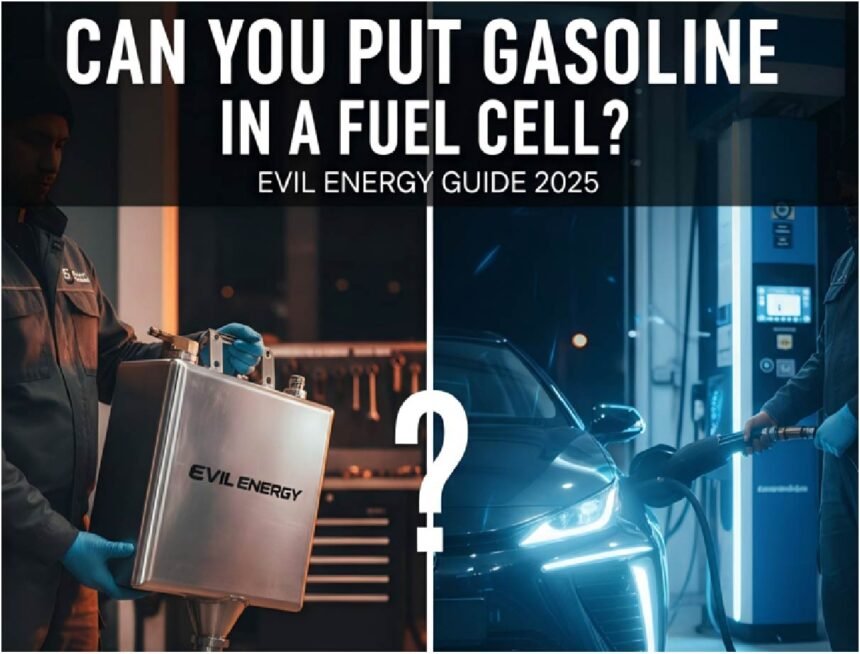
In the world of automotive performance and Reddit communities like r/projectcar or r/drifting, the term “Fuel Cell” is one of the most misunderstood phrases.
Depending on who you ask, a fuel cell is either a high-tech green energy source or a rugged tank that keeps a race car from exploding. If you are looking at EVIL ENERGY fuel cells or searching for fuel cell gasoline, you need to know which one is which before you make a costly (or dangerous) mistake.
At a Glance: The “Fuel Cell” Cheat Sheet
| Feature | Racing Fuel Cell (e.g., EVIL ENERGY) | Hydrogen Fuel Cell (e.g., Toyota Mirai) |
| Primary Use | Safe fuel storage for racing/drifting | Generating electricity to power a motor |
| Fuel Source | Liquid Gasoline, E85, or Methanol | Compressed Hydrogen Gas |
| Why use it? | Prevents fuel slosh and fire during crashes | Zero-emissions driving |
| Common Parts | Aluminum tank, anti-slosh foam, AN fittings | Fuel cell stack, high-pressure hydrogen tanks |
The Basics: What is a gasoline fuel cell?
In the context of performance tuning, a gasoline fuel cell is a specialized, high-security fuel tank.
Unlike a standard plastic or thin metal OEM tank, a racing fuel cell (like those from EVIL ENERGY) is designed to survive high-impact crashes. It typically consists of a heavy-duty aluminum or steel outer shell and is filled with safety foam to prevent the fuel from sloshing around. This ensures the fuel pump always has a steady supply, even during high-G cornering.
The “Reddit Questions”: Gas, Hydrogen, and Compatibility
What gas is used in a fuel cell?
The word “gas” causes 99% of the confusion.
- In a Racing Fuel Cell: “Gas” refers to liquid gasoline (petrol).
- In a Fuel Cell Vehicle (FCEV): “Gas” refers to Hydrogen gas (H2).
If you are building a project car for the track, you are looking for a tank to hold liquid gasoline. If you are talking about the future of transportation, you are talking about gaseous hydrogen.
Can you put gas in a fuel cell?
The answer is: It depends on the hardware.
- YES: You can and should put gasoline in a racing fuel cell like an EVIL ENERGY fuel cell. These are specifically engineered to hold gasoline, E85, or racing fuels.
- NO: You must never put gasoline in a hydrogen fuel cell vehicle. Putting liquid gasoline into a hydrogen tank would destroy the system and create a massive fire hazard.
What Users Really Want to Know: The “Pro” Level Info
A. Is a Fuel Cell Street Legal? (The “DOT” Dilemma)
This is the most debated topic on r/ProjectCars.
- The Reality: Most aluminum fuel cells (including EVIL ENERGY) are not DOT-approved.
- The Risk: In many states, if a cop sees a fuel cell in your trunk during a routine stop, you could be ticketed. Furthermore, some insurance companies may deny a claim if an “unauthorized fuel tank” was involved in an accident.
- The Verdict: Great for the track; “grey area” for the street.
B. The “Gas Smell” Issue (Permeation)
A common complaint after installing an EVIL ENERGY fuel cell is a lingering smell of gasoline in the garage.
- The Cause: It’s usually not the tank! It’s the rubber fuel lines. Standard rubber hoses allow fuel vapors to “seep” through the walls.
- The Fix: Always pair your fuel cell with PTFE-lined (Teflon) hoses. PTFE is vapor-proof and will keep your garage smelling clean.
C. Sumped vs. Non-Sumped: Which do you need?
You’ll notice some EVIL ENERGY tanks have a small “box” at the bottom. This is a Sump.
- Why it matters: In drag racing or drifting, gravity pulls fuel to the back/side of the tank. A sumped tank ensures the fuel pickup is always submerged in gas, preventing lean-out conditions that can blow up your engine.
Comparison: Standard Tank vs. EVIL ENERGY Fuel Cell
| Feature | Factory Gas Tank | EVIL ENERGY Fuel Cell |
| Baffles/Foam | Minimal or None | High-density Safety Foam |
| Material | Plastic or Thin Steel | 1/8″ Thick Aluminum |
| Fittings | Specific OEM clips | Universal AN6/AN8/AN10 |
| Weight | Heavy/Bulky | Lightweight & Compact |
| Surge Protection | Poor | Excellent (with Sump) |
Why is EVIL ENERGY the “Reddit Favorite” for Fuel Cells?
If you browse r/240sx or r/budgetbuilds, you’ll see EVIL ENERGY mentioned constantly. They have become a go-to brand for grassroots drifters and racers for several reasons:
- Anti-Slosh Technology: Their cells come with internal foam that prevents “fuel starvation”—that annoying moment when your engine stutters in a drift because the gas sloshed away from the pump.
- Safety Features: They include 0-90 Ohm fuel units and anti-tip valves that seal the tank if the car flips over.
- Affordability: They offer alloy 1060-H24 aluminum tanks at a fraction of the cost of FIA-certified professional cells, making them perfect for amateur builds.
What type of gas do fuel cell cars use?
To be clear, actual Fuel Cell Cars (like the Toyota Mirai or Hyundai Nexo) use Compressed Hydrogen Gas.
These cars don’t “burn” the gas in an engine. Instead, they pass the hydrogen through a “cell stack” where it reacts with oxygen to create electricity. The only “exhaust” is pure water (H2O).
Pro-Tip: The “E85 Warning” for EVIL ENERGY Users
A trending topic on car forums is E85 compatibility. If you plan to run E85 (ethanol) in your EVIL ENERGY fuel cell, check the foam!
Warning: Some standard safety foams can break down over time when exposed to high concentrations of ethanol. If the foam degrades, it will clog your fuel filters and injectors. Always verify your foam is “alcohol-resistant” if you aren’t running pump gas.
Summary
If you are looking for fuel cell gasoline solutions for your race car, an EVIL ENERGY fuel cell is a durable, budget-friendly way to upgrade your fuel system. Just remember: you’re buying a better “bucket” for your gasoline, not a hydrogen engine!