



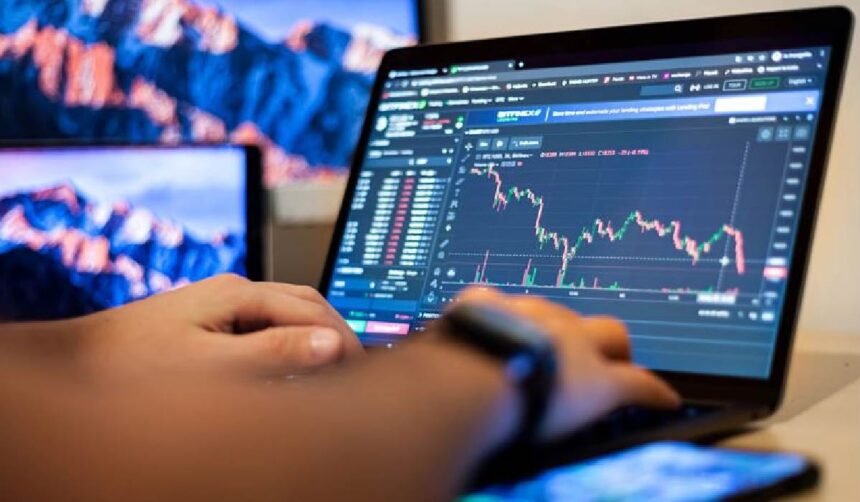
November 2025 has reawakened volatility across global markets after several months of consolidation. Traders and investors have entered the final stretch of the year balancing optimism about cooling inflation with anxiety about sluggish growth. The U.S. Federal Reserve, the European Central Bank, and the Bank of England have all maintained a cautious tone, signaling that while rate hikes are likely over, monetary easing will not begin until the data supports it. This hesitation has translated directly into financial markets, where sentiment now shifts daily between relief and restraint.
Equities have reflected this tension. U.S. indices, particularly the Nasdaq and S&P 500, have traded within defined ranges, staging brief rallies on earnings optimism before retreating on stronger bond yields. In Europe, markets remain defensive, with investors rotating into utilities and consumer staples. In Asia, sentiment is divided — Japan’s steady growth contrasts sharply with China’s uneven recovery. Each of these dynamics has generated short-term volatility, creating fertile ground for CFD traders who thrive on movement rather than direction.
Commodities have amplified the sense of instability. Crude oil prices have fluctuated around the 80-dollar mark, whipsawed by every rumor of supply cuts or demand downgrades. Gold has tested its resistance near 2,000 dollars per ounce multiple times as investors hedge against uncertainty. Currency markets have been equally active, with the U.S. dollar showing signs of fatigue while the euro and pound regain modest strength. This global interplay of shifting momentum is what defines CFD trading opportunity in November — a month where markets move more on perception than on fundamentals.
Trading the Noise: How Events Shape Price Action
November has reminded traders that financial markets are no longer driven by long-term conviction but by short-term reaction. Each headline — a policy statement, an inflation figure, an earnings revision — sends waves through equities, commodities, and forex alike. For CFD traders, this environment is both a challenge and a gift. The challenge lies in distinguishing between genuine trend development and temporary noise; the gift lies in the frequency of tradeable setups.
The first week of the month brought the latest U.S. labor market data, which showed a slight uptick in unemployment and slower wage growth. Markets initially sold off on fear of stagnation but quickly reversed as traders interpreted the numbers as evidence of softening inflation. Within hours, major indices had retraced their losses. Such reversals are exactly what define November’s price structure: fast reactions followed by equally fast corrections.
In Europe, the ECB’s policy comments added another layer of volatility. While the central bank reiterated its cautious stance, traders reacted to subtle language changes in the statement that hinted at future flexibility. The euro spiked briefly, then settled, leaving intraday traders with opportunities to capture the extremes. The same rhythm played out in the UK following new inflation readings that undershot expectations. The pound rallied on relief, then drifted as traders absorbed the implications.
CFD markets magnify these moments because they offer access to multiple asset classes through the same trading interface. A trader watching oil can instantly move to trade the pound or Nasdaq futures without delay. This ability to respond across instruments allows flexibility but demands discipline. November’s events have reinforced that success in CFD trading depends not on predicting the event itself, but on reading the reaction that follows.
Managing Risk Amid Momentum
As volatility returns, the discipline of risk management becomes the foundation of all CFD trading. November’s market has rewarded speed, but punished excess. Leverage — a double-edged tool central to CFD trading — has amplified both profits and losses. In this month’s conditions, traders who overexposed positions on the wrong side of volatility have learned that market speed can erase capital faster than it creates it.
Successful CFD traders this month are those who respect the structure of risk. They set precise entry and exit points, size positions conservatively, and let volatility work for them instead of against them. November’s market has not been chaotic, but it has been relentless. Prices move sharply, pause briefly, and then move again in the opposite direction. Those who chase reversals without confirmation often find themselves trapped in false momentum, while those who wait for structure capture controlled swings.
Liquidity has improved across most CFD instruments, allowing smoother execution. However, spreads have widened temporarily during high-impact events, especially around economic data releases and policy briefings. This environment rewards patience — the discipline to wait until volatility settles before entering. The traders who adapt to this pace understand that CFD trading is less about prediction and more about precision. Each move must be treated as a probability, not a certainty.
Outlook: Opportunity Through Structure
As November continues, CFD trading remains one of the most flexible ways to engage with a shifting financial world. The mix of moderate volatility, deep liquidity, and diverse asset performance has created an ideal playground for those who know how to manage exposure. The most successful traders this month are not those who guess where the market will go, but those who respond effectively to what it is doing.
Looking ahead, several macro catalysts remain on the horizon — further inflation data, retail sales figures, and the final round of corporate earnings before the year ends. Each of these will trigger short-lived bursts of volatility. For CFD traders, these bursts are the heartbeat of opportunity. Every spike or retracement offers a lesson in patience and timing, a chance to act with clarity while others react with emotion.
The broader theme of November 2025 is adaptability. Markets are moving again, but not in predictable ways. The traders who will end this month in profit are those who have mastered two skills: emotional control and structural awareness. CFD trading demands both — the ability to detach from headlines while reading the rhythm of price action in real time.
In a financial environment defined by rapid change, CFDs remain the instrument of the agile. They allow traders to express conviction, hedge uncertainty, or simply ride volatility without long-term commitment. November has made one thing clear: in a market where confidence rises and falls within hours, success belongs not to those who predict the future, but to those who trade what’s right in front of them — the chart, the flow, and the moment itself.