



Buildings rarely reveal everything at once. Some announce their intentions immediately, while others unfold gradually, rewarding closer attention over time. Charred timber belongs to the latter category. Its presence in contemporary architecture has grown quietly, not through spectacle, but through repeated use by designers who value restraint, longevity, and materials that do not rely on explanation to justify themselves.
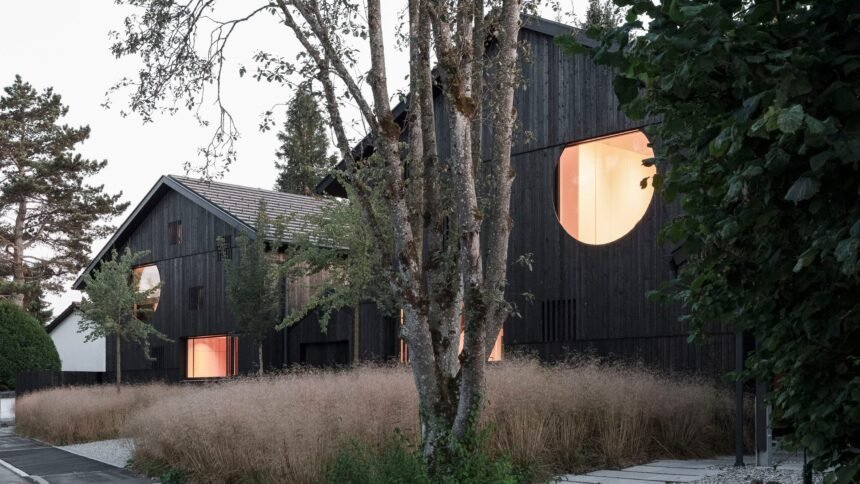
At first encounter, the surface tells most of the story. The grain is pronounced, sometimes uneven, and unmistakably tactile. Light behaves differently across charred timber, catching raised fibres and settling into darker recesses. There is no attempt to disguise the process behind the material. Instead, the evidence of transformation is left visible. This honesty gives façades a sense of depth that smooth or coated finishes rarely achieve, even when those finishes are technically advanced.
Time plays a decisive role in how this material is understood. Unlike many external treatments chosen for how they look on completion day, charred timber anticipates change. Weather softens contrasts, edges lose sharpness, and tones settle into something quieter. This evolution does not undermine the building; it completes it. In this context, ageing is not a failure of performance but an extension of design intent.
The technique itself is uncomplicated. Timber is exposed to controlled heat, altering its outer layer without introducing chemical preservatives or synthetic films. This change reduces moisture absorption and discourages surface-level decay, addressing two of the most persistent weaknesses associated with external timber. Long before sustainability targets became formalised, this approach was already delivering durability through simple, repeatable means.
In today’s construction environment, that simplicity carries renewed relevance. Designers are increasingly cautious of materials that rely on layered systems and repeated treatments to maintain performance. Charred timber offers an alternative. Once installed correctly, it demands little intervention, allowing buildings to exist without constant cycles of repair or cosmetic renewal that often bring environmental and financial costs.
Residential architecture has embraced the material for its ability to create calm, grounded compositions. Dark façades establish clear boundaries while avoiding heaviness, particularly when balanced with glazing or lighter secondary elements. In rural contexts, charred timber echoes the textures of bark and shadow. In urban settings, it introduces warmth into streetscapes dominated by glass, metal, and concrete.
Across the UK, interest in Shou Sugi Ban wood has grown steadily rather than dramatically. This measured adoption suggests confidence rather than experimentation. Architects return to it not because it is fashionable, but because it behaves predictably and offers a visual language that works across varied contexts without dominating them.
Commercial projects approach the material slightly differently. Here, charred timber is often used to soften scale. Long elevations benefit from the rhythm of timber boards, which break down mass and introduce a more human proportion. Offices, galleries, and hospitality spaces use it to communicate permanence and care, even when the internal programmes are flexible or fast-moving.
Installation remains a decisive factor in long-term performance. Ventilation gaps, fixings, junctions, and detailing around openings all influence how the material responds over time. When these elements are treated as integral rather than secondary considerations, charred timber performs with quiet reliability. When they are overlooked, even robust materials struggle to meet expectations.
What has become increasingly apparent is how external material choices influence interior decisions. Rather than separating façade design from internal finishes, many projects now seek continuity. Timber wall panels inside buildings mirror the external cladding, creating a sense that the structure is coherent rather than assembled from unrelated ideas.
The use of timber wall panels internally allows materials to soften acoustics, temper light, and introduce warmth without decoration. Spaces feel calmer and more settled, an effect particularly valued in workplaces and hospitality environments where atmosphere shapes experience as much as function.
Internally, timber also changes how people move through spaces. It absorbs sound differently, reduces harsh reflections, and encourages a slower pace. These subtle effects are difficult to quantify, yet they influence how buildings are used every day. Designers increasingly recognise that comfort is not only about layout or temperature, but also about how surfaces behave over time.
There is a broader cultural shift underpinning this renewed interest. Architecture has grown wary of surfaces that imitate something they are not. Materials that express their origin and method of transformation feel more honest. Charred timber does this openly, carrying its process on its surface rather than hiding it beneath coatings or artificial textures.
As regulatory frameworks evolve, materials must now perform on multiple levels. Fire performance, durability, responsible sourcing, and lifecycle impact all matter. Charred timber, when specified and certified correctly, can meet these expectations while still offering a distinctive architectural presence that avoids the sterility of purely technical solutions.
Perhaps the most compelling aspect of charred timber’s return is how little it demands attention. It does not seek to impress through novelty. Instead, it settles into a building and allows other elements to speak. Over time, this restraint becomes its defining quality.
In an industry often driven by speed and short-term outcomes, charred timber encourages patience. It rewards careful detailing, accepts change, and contributes quietly to the identity of a building. That kind of material honesty is difficult to manufacture, and once found, it tends to endure far beyond the moment of completion.
Charred Timber and the Slow Shift Toward Material Honesty
Leave a comment
Leave a comment

Tracey Hinds Revealed: Insights into the Life of Macy Gray’s Former Husband
Tracey Hinds, known to many primarily as the ex-husband of renowned R&B singer Macy Gray,…

Discover the Charm of Kanagarajan Street Foreshore Estate: A Comprehensive Guide
Introduction: Kanagarajan Street Foreshore Estate Foreshore Estate: A Cultural and Geographical Overview Foreshore Estate is…

Who Is Jacqueline Bernice Mitchell?: Everything About Jerry Rice Ex-Wife
Jacqueline Bernice Mitchell is often recognized for her former marriage to NFL legend Jerry Rice,…