



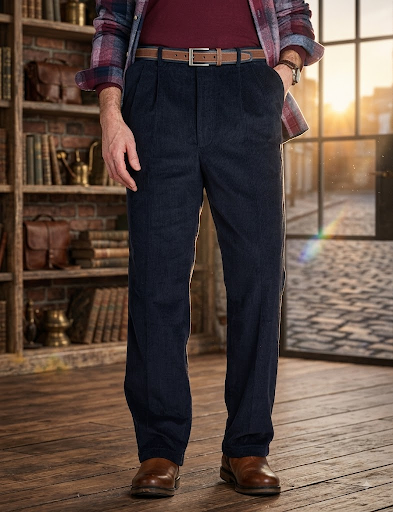
There’s a particular kind of satisfaction that comes with rediscovering something you’d written off. Corduroy trousers are having that moment right now, turning up on high streets and in wardrobes that haven’t seen a ribbed trouser since 1997. But here’s the thing: for a lot of people, particularly men over fifty, corduroy never actually went anywhere. It just waited quietly until everyone else caught up.
The fabric itself has a genuinely odd history. It was once considered the cloth of French kings, then became associated with artists and academics, then got filed under “Dad at the school gates in 1989,” and now it’s somehow landed in the same conversation as proper contemporary menswear. Fashion is strange like that. What gets dismissed as unfashionable in one decade tends to come back carrying a bit more authority the next time round.
Why Corduroy Actually Works in British Weather
Most trouser fabrics make a quiet compromise between comfort and warmth. Corduroy doesn’t really bother with that compromise. The ridged weave (the technical term is “wale,” which refers to the width of each cord) creates tiny channels across the surface of the fabric that trap warm air. In practice, this means they’re noticeably warmer than a standard cotton chino, without the bulk of a wool trouser that needs dry cleaning every five minutes.
For the kind of October-to-March stretch that most of Britain endures, that’s not a small thing. You can wear them walking the dog in the morning and still look perfectly presentable if you end up stopping somewhere for lunch. They survive wind and light drizzle without looking completely bedraggled, which is more than can be said for linen, and they don’t cling the way synthetic fabrics sometimes do in damp air.
Wide wale corduroy, the kind with fat, obvious ribs, tends to read as more casual. Narrow wale is closer to a smart trouser in terms of how it sits and how it reads from a distance. If you’re after something that works for a slightly smarter setting without committing to formal tailoring, narrow wale is usually the better call.
Getting the Fit Right
Corduroy has a reputation for being a bit shapeless, and that reputation isn’t entirely unfair. Bad corduroy trousers, usually very wide in the leg and a bit bagging at the knee, do exist and they do look exactly as frumpy as the stereotype suggests. But that’s a fit problem, not a fabric problem.
A well-cut pair of corduroy trousers should sit cleanly at the waist, follow the line of the thigh without being tight, and have enough room below the knee to move comfortably without that fabric bunching around your ankles. It sounds obvious when you write it down, but it’s the bit most people get wrong, partly because corduroy is often bought in the same size as denim without accounting for the fact that the fabric behaves differently.
Elasticated waistbands have improved enormously in recent years, worth saying for anyone who’s avoided them based on how they looked fifteen years ago. The modern versions sit flat, don’t create ridges under a shirt, and give you enough flexibility that a pair of cords remains comfortable all day.
What to Actually Wear Them With
Brown, tan, and dark green corduroy trousers are the most versatile. They work with almost any shade of knitwear and sit perfectly alongside brown leather boots or suede shoes. Navy cords are a little harder to style because they can clash with navy tops in a way that looks unintentional rather than coordinated, though they look great paired with cream or oatmeal jumpers.
That’s one of the underrated things about corduroy as a trouser fabric is that it does a lot of the visual work on its own because of the texture, so the rest of what you’re wearing doesn’t have to try quite as hard; a thick shirt worn untucked, a chunky-knit pullover, or a waxed jacket doesn’t require any effort to look put-together.
If you haven’t revisited cords in a while, autumn is exactly the right time to start. The fabric was built for this kind of weather, and the options available now are considerably better cut than the ones gathering dust at the back of your wardrobe from twenty years ago.