



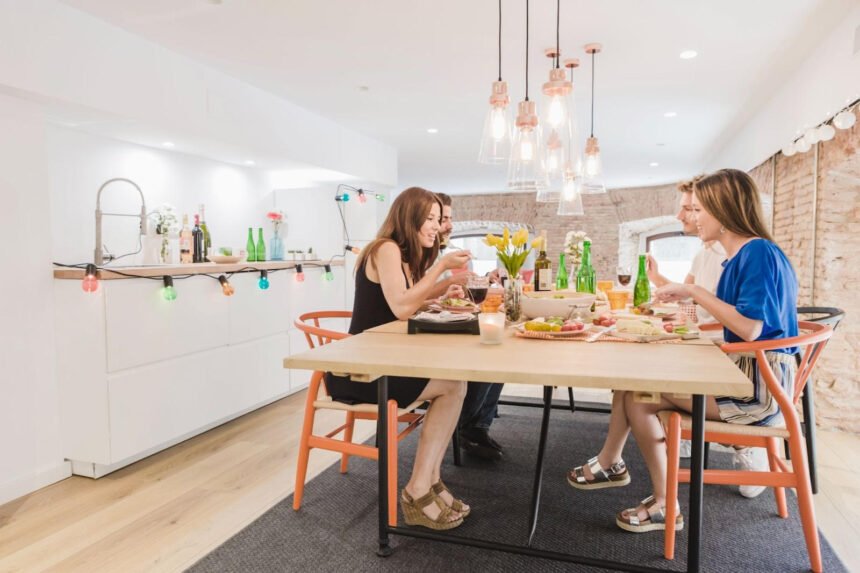
Your dining room is more than just a place to eat. It’s where families gather, friends connect, and special moments happen. But even a beautiful home can feel off if the dining space is not designed well. Small mistakes, like the wrong table size or poor lighting, can make the room feel crowded, dull, or uncomfortable.
The good news is that these problems are easy to avoid once you know what to look for. In this blog, we’ll walk through common dining room design mistakes and share simple tips to help you create a space that feels open, warm, and welcoming.
Layout Mistakes That Break Flow (and Make the Room Feel Smaller)
Your furniture might photograph beautifully, but if navigating around it requires Olympic-level agility, you’ve got a serious issue. Layout blunders are far and away the fastest way to accidentally strangle your dining room.
Clearance Failures Around the Table (The #1 Mistake)
This single error cascades into every other problem. When you skimp on space between your table and walls or adjacent furniture, you’ve created an indoor maze. Home planning pros say you need at least 90 cm for primary walking paths (roughly 36 inches), which is the absolute minimum for passing behind someone who’s seated without performing an awkward shimmy.
Most design authorities push for 36–48 inches from the table edge to any obstruction. You’re also looking at 24 inches per person for elbow room and dishware. The dining room sets can help maximize space, while pedestal-base tables and slimmer chairs along walls buy you precious inches.
Wrong Table Shape for Your Footprint
Jamming a rectangular table into a square room creates visual tension. A giant round piece in a narrow hallway-style space becomes a barricade. Syncing your table shape to your room’s actual dimensions ranks among the smartest dining room layout ideas out there. Elongated, narrow rooms pair naturally with rectangular or oval tables. Square rooms? Round or square tables work. Tight quarters with multiple doorways? Ovals soften collision points and flow better.
Before spending a dime, grab painter’s tape and outline the table plus chair zones directly on your floor. Walk it. Open every door. This “tape test” catches disasters before they drain your wallet.
Door Swings, Pathways, and Open-Concept Collision Zones
Open floor plans pit your dining area against kitchen traffic, living room movement, and back door access. If your table plants itself smack in the middle of a main artery, you’ll spend dinners constantly asking people to move. The workaround? Rotate your table ninety degrees when traffic slices through lengthwise. Drop an area rug to carve out a visual “dining zone.” Position a slim console or narrow shelf behind chairs to prevent furniture creep into walkways.
Scale & Proportion Mistakes That Make the Room Look “Off”
Even perfectly scaled furniture falls flat without strategic lighting, and most dining rooms dump all responsibility on one fixture, which handles it poorly.
Table Too Big or Too Small for the Room
An oversized table transforms your room into a furniture warehouse. Too petite? It floats there looking lost and apologetic. The sweet spot involves maintaining at least 36 inches of breathing room on all functional sides, and keeping the table under roughly two-thirds of the room’s length in typical spaces. For adaptability, extendable tables handle both “Tuesday family dinner” and “hosting twelve” scenarios. Drop-leaf or gateleg designs are absolute heroes in compact apartments.
Lighting Mistakes That Flatten the Mood (and Ruin Photos)
Insufficient legroom can make your living area feel crowded and disrupt the flow of movement, especially when entertaining guests. The identical principle applies to lighting; poorly chosen fixtures congest visual space and murder the ambiance.
Chandelier Size and Height Mistakes Over the Table
Position your chandelier 30-34 inches above the table surface (tweak slightly for dramatically tall ceilings). The fixture width should measure roughly half to two-thirds of your table’s width. An undersized chandelier reads as an afterthought. Oversized? It bullies the space and creates brutal glare. Always opt for dimmable fixtures so you can shift from “Wednesday pasta night” to “impressing the boss” seamlessly.
Dining Room Sets Mistakes That Lock You Into the Wrong Look
Styling elements inject personality, but countless homeowners trap themselves by choosing dining room sets without pressure-testing against real-world demands.
Buying Dining Room Sets Without Measuring Real-Life Use Cases
Rather than falling for showroom staging magic, treat dining room sets as rough templates that demand reality testing against your actual lifestyle. They consistently look flawless under professional lighting in spacious displays, but crumble at home because you skipped accounting for how you genuinely live. Need accommodation for weeknight family dinners, a homework station, or regular entertaining for eight to ten people? Build a “requirements list” before committing. Measure everything, verify clearances, and confirm the set flexes across multiple scenarios, not just the Instagram-perfect fantasy in your imagination.
Matching Everything Too Perfectly
The matchy-matchy showroom aesthetic lands sterile and lifeless. Create deliberate contrast: mix different chairs at table ends, intentionally blend wood tones, add counterpoint through lighting or rugs. This fights the “catalog clone” trap and gives your space genuine character. Also, prioritize durability over aesthetics in family households, performance fabrics, wipeable surfaces, and rounded edges, which prevent future headaches.
Modern Dining Room Layout Ideas That Prevent Mistakes Upfront
These layout strategies deliver results, but before committing to any purchase, run this quick audit to catch hidden errors that could wreck your space.
The “Tape Test” Layout Method
Use painter’s tape to map your table outline, chair pullback zones, and traffic paths straight onto the floor. Live with it for forty-eight hours. Walk through repeatedly. Test every door swing. Sit in phantom chairs. This costs virtually nothing and rescues you from expensive returns. Lock down table shape, rug dimensions, and sideboard depth before hitting stores.
Zoning an Open-Concept Dining Area Without Walls
Deploy your rug, lighting, and a streamlined console as visual borders in open layouts. A painted ceiling detail or subtle overhead beams can anchor the dining zone without walling it off. This prevents your dining area from bleeding into adjacent living or kitchen zones and maintains spatial organization.
Your Most-Asked Dining Room Questions
Which dining room design mistakes make a room look smaller instantly?
Inadequate clearances and oversized tables top the list. When walking around, your table demands contortionist skills, and the room feels suffocating. Solve it by downsizing the table or swapping bulky buffets for wall-mounted storage.
What is the ideal spacing around a dining table for comfortable seating and walking?
Maintain 36-48 inches from the table edge to walls or furniture for smooth circulation. You also require 24 inches per person for place settings and elbow freedom. These measurements eliminate awkward squeezing during meals.
Which dining room layout ideas work best for open-concept living rooms?
Leverage rugs, lighting, and consoles as visual boundaries. Rotate your table to dodge traffic conflicts, and select round or oval shapes to soften hard corners. These tactics define your dining zone without physical walls.
Wrapping Up Your Dining Room Design
The most common dining room errors, cramped clearances, mismatched table sizes, inadequate lighting, and proportion failures, aren’t complicated to remedy once you recognize the patterns. Deploy the “tape test,” design for actual usage patterns, and build lighting in layers.
Your dining room deserves to work as hard as you do, handling routine weeknight dinners and special occasions without friction. Nail the fundamentals, and everything else clicks into place. You’ll end up with a space that’s genuinely functional, visually appealing, and truly enjoyable to use every single day.