



Disclosure: I’m the founder of an artisan candle company, and while I’ll share insights from my own practice, the principles here reflect broader industry standards and best practices in handmade candlemaking.
In a world of mass production and algorithm-driven convenience, the handmade candle stands as something increasingly rare, a fusion of chemistry, patience, and sensory craft. Far more than a simple home accessory, a well-crafted handmade candle embodies a centuries-old dialogue between material, maker, and moment. From the careful selection of wax to the precise setting of the wick, every step in the process is a decision that shapes not only how the candle burns but how it transforms a space.
The Foundation: Choosing Your Wax
The journey begins with wax, the soul of the candle. While many commercial brands still rely on paraffin, a petroleum byproduct that’s inexpensive and consistent, artisan makers are increasingly exploring renewable alternatives, each with distinct characteristics.
Rapeseed wax, grown across UK and European countryside, offers a slow, even burn with excellent scent throw. It’s become popular among British makers for its local sourcing and clean burn profile. Coconut wax, often blended with rapeseed, provides a creamy texture and superior fragrance adhesion, though it typically needs to be imported. Soy wax remains widely used in the US and offers good performance at accessible price points. Beeswax, harvested from local hives, burns with a warm, honeyed glow and naturally subtle fragrance, though research on its air-purifying claims remains mixed (Tatár et al., 2020).
In my early days, I learned that no single wax is “best”, each serves different needs. A meditation candle might call for pure beeswax; a heavily scented statement piece might need coconut-rapeseed blend. The choice depends on your priorities: scent throw, burn time, sustainability, or aesthetic.
Fragrance: Where Science Meets Story
Next comes fragrance, where chemistry meets intuition. Unlike perfumes designed for skin, candle fragrances must survive high-temperature pouring (often 60-85°C depending on wax type), bind to wax molecules, and release consistently over dozens of hours.
Reputable artisans typically use IFRA-certified fragrance oils that meet safety standards and avoid phthalates and known irritants. Essential oils are also used, though they require careful blending, some oils (like citrus) can be unstable at high temperatures, while others (like clove) may irritate in concentrated forms.
But beyond chemistry, fragrance is storytelling. A blend of bergamot, cedar, and vetiver might evoke a foggy morning in the Lake District; wild mint and damp earth could capture a woodland walk after rain. The best makers, whether they’re in Nottingham, Brooklyn, or Melbourne, treat scent as narrative, a mood captured in wax.
One mistake I made early on: overloading fragrance. More isn’t better. Most waxes hold 6-10% fragrance oil optimally; beyond that, you risk poor burn performance and weak scent throw as excess oil pools at the bottom.
The Unsung Hero: Wick Selection
Then there’s the wick, often overlooked, yet critical to performance. Made from cotton, wood, or cotton-paper blends, the wick must be precisely matched to the wax type, container diameter, and fragrance load.
Too thin, and the candle tunnels down the center, wasting wax. Too thick, and it produces excess smoke, soot, or dangerously large flames. Artisans test burn after burn, adjusting variables until achieving the perfect “melt pool”, a full, even liquefaction across the surface within two to four hours of the first burn.
This isn’t guesswork. There are wick sizing charts and calculators, but they’re starting points. Humidity, altitude, and even the shape of your vessel affect performance. I’ve reformulated candles three or four times to get the wick right, and I’m not alone, most serious makers consider testing as fundamental as the pouring itself.
The Pour: Patience Over Speed
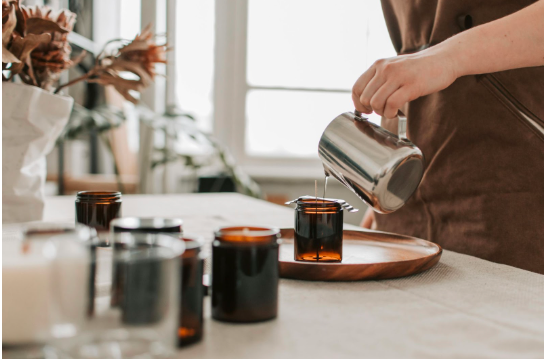
The pouring process itself rewards patience. Wax is gently melted at controlled temperatures to preserve its structure, then cooled to an optimal range (typically 55-65°C for many natural waxes, though this varies by type) before being hand-poured into vessels.
Rushing this step causes problems: pour too hot and you risk cracking or discoloration; too cool and you get poor adhesion or surface imperfections. Many artisan makers pour in small batches, sometimes just 10-20 candles at a time to maintain consistency and quality control.
After pouring, candles typically cure for 1-2 weeks, though some makers prefer longer. This isn’t an arbitrary wait, it’s a crucial phase where fragrance molecules fully integrate with the wax structure. Mass producers often skip or minimize curing to speed products to market, which is why some commercial candles have weak or an uneven scent throw.
Sustainability: From Intention to Practice
Sustainability has become central to the craft, though it’s important to acknowledge that “handmade” doesn’t automatically mean “eco-friendly.” Thoughtful makers consider environmental impact at every stage: recycled or reusable glass vessels, plastic-free packaging, responsibly sourced botanicals, unbleached cotton wicks, and renewable waxes.
Some offer refill programs, encouraging customers to return jars rather than disposing of them. Others partner with local suppliers to minimize shipping impacts. But it’s worth noting that sustainability is a spectrum, not a binary. A beeswax candle shipped internationally may have a larger footprint than a locally made soy candle, despite beeswax being “natural.”
The key is transparency,makers who are honest about their practices and trade-offs tend to earn more trust than those making sweeping environmental claims.
The Reality of Handmade: Imperfection as Character
This craft also demands humility. Humidity, ambient temperature, and barometric pressure can all affect a batch. A candle that performs flawlessly in summer may tunnel in winter. Frosting (a crystalline surface pattern) is common in natural waxes and entirely harmless, but it surprises customers expecting showroom perfection.
This variability is why handmade candles are rarely identical and why many makers redefine perfection as character rather than uniformity. Each subtle variation, the way rapeseed wax develops a unique frost pattern, how base notes emerge differently across batches is a fingerprint of its making.
I’ve learned to embrace this. When a customer emails about slight color variations between two candles from different batches, I explain the reality of working with natural materials. Most appreciate the honesty; some prefer the predictability of commercial products. Both responses are valid.
How to Use and Choose Handmade Candles
For consumers, understanding this process transforms how you use candles:
- First burn matters most: Always burn long enough for the wax to melt fully to the edges (usually 2-4 hours). This prevents tunneling for the life of the candle.
- Trim the wick: Cut to about 5mm before each lighting to prevent smoking and ensure clean burn.
- Rotate your scents: Olfactory fatigue is real, you’ll stop noticing a fragrance after extended exposure.
- Store properly: Keep candles away from direct sunlight and heat, which can affect color and scent.
When choosing handmade candles, look for makers who are transparent about their materials, processes, and sourcing. Ask questions: What wax do you use? Where does it come from? How long do you cure your candles? Do you test burn each new scent?
Quality exists at various price points, a more expensive candle isn’t always better, but rock-bottom prices often signal corners cut somewhere in the chain. Whether you’re shopping on Etsy, at local markets, or through established artisan brands, maker transparency is your best guide.
Why This Craft Endures
This meticulous, human-centered approach is why handmade candles command growing devotion. In an era of disposable everything, they offer ritual, presence, and sensory grounding. Lighting one becomes a pause, a small ceremony of warmth and intention in an otherwise hurried day.
And while machines can replicate shape, they cannot replicate soul. The handmade candle, with its imperfections and provenance, reminds us that beauty often lives in the space between precision and poetry and where wax meets wick, and craft meets care.
Author Bio
Matthew Romane is the founder of Matty’s Candles, a Nottingham-based artisan candle and wax melt company specializing in handcrafted, eco-friendly home fragrances. With years of experience creating custom scent blends and helping customers discover their perfect fragrance profiles, Matty combines traditional candlemaking techniques with sustainable practices.
Learn more at mattyscandles.co.uk
References
International Fragrance Association (IFRA). “IFRA Standards for Safe Use of Fragrance Materials.
Moss, M., et al. (2008). “Modulation of cognitive performance and mood by aromas of peppermint and ylang-ylang.
Journal of Essential Oil Research. (2021). “Stability and efficacy of essential oils in natural wax matrices.” Vol. 33, Issue 5, pp. 411–420.