



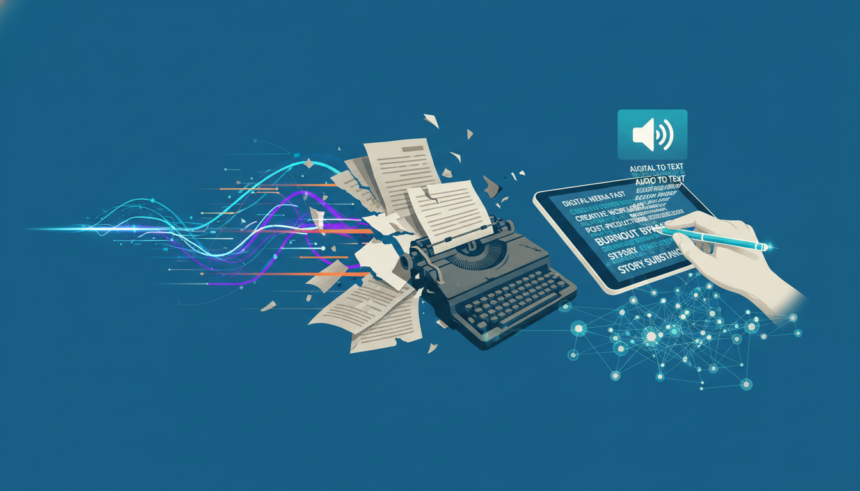
Digital media moves fast—and honestly, too fast for old-school transcription to keep up. Whether you’re cutting a two-hour chat into tight show notes or filing copy before a midnight desk close, I’ve watched raw audio stall a draft right where momentum should build. Get a dependable bridge here and, suddenly, your creative workflow feels different—in the best, slightly chaotic way.
The Reality of Post-Production for Modern Creators
The romanticized image of a journalist meticulously re-listening to every second of an interview to catch the perfect nuance is, in practice, a recipe for burnout. Most professionals I know are looking for a way to bypass the manual labor without sacrificing the soul of the conversation. When you first integrate an audio to text converter into your routine, the shift in your mental bandwidth is immediate because you are no longer focused on the mechanics of typing but on the substance of the story.
Why Manual Transcription is a Relic of the Past
There is a specific kind of fatigue that sets in after forty minutes of hitting the backspace key to catch a muffled phrase. I’ve noticed that the more time a creator spends on the mechanical task of transcribing, the less energy they have for the actual editorial judgment that makes their work stand out. Using an audio to text converter isn’t just about saving time; it’s about preserving your creative “spoons” for the tasks that require human intuition, like framing a difficult narrative or identifying the emotional hook of a guest’s response.
Navigating the Nuances of Speaker Identification
Early auto-transcription had that dreaded wall-of-text vibe—no sense of who’s asking and who’s answering. Today’s tools actually nail speaker diarization, which matters a lot in panel chats or rapid-fire debates. It lets you see the cadence on the page, so pulling quotes that sound like the person—not a scrubbed rewrite—gets a lot easier.
Turning Raw Interviews into High-Performance Show Notes
For podcasters, the audio file is only half of the product. The other half is the messy-but-crucial stuff—metadata, an SEO-friendly blog, and those social snippets that make people hit play. If you skip the full transcript or at least solid, time-stamped notes, you’re basically a ghost to search engines. An audio to text converter acts as your primary engine for visibility, turning spoken insights into indexable content that Google can actually understand and rank.
The Strategy of AI-Driven Summarization
I’ve found that the real magic happens after the transcription is complete. Having an AI-generated summary of a two-hour recording allows a producer to quickly scan for key themes without needing to listen to the whole file again at 1.5x speed. It’s a lifesaver for those quick “TL;DR” bits in newsletters or teaser posts. Skim the summary, glance at the full text, and you’re suddenly mapping a week of promos in the time one paragraph used to steal.
Optimizing for Accessibility and Global Reach
We all obsess over SEO, but the human side of accessibility matters just as much to me. A big slice of your audience is in places where audio’s a no-go—or they’re hard of hearing—so text isn’t optional. Share a clean text version and you’re not just wooing the algorithm—you’re opening the door to more listeners. It’s smart business and, frankly, it lines up with the basic decency of making info available however people take it in.
Handling Large-Scale Media Assets and Cross-Platform Workflows
In a professional studio environment, you are rarely dealing with just one type of file. The workflow often involves high-resolution video files alongside raw audio stems. Managing these assets requires a suite of tools that work in harmony. For instance, before uploading video content to a platform or sending it over a limited connection, a creator might use a video compressor to ensure the file size is manageable without losing the visual fidelity required for social clips. This kind of tactical tool usage is what separates a hobbyist from a professional who understands the value of a streamlined pipeline.
Integration into the Editorial Calendar
I hear this a lot from beat reporters in medicine or tech: can the AI survive their jargon? In my experience, while none of this is perfect, the current models are surprisingly good at catching context and nailing most technical spellings. And if a term’s a little wonky, a 95% draft beats the blank-page stare every single time. Pop open search, grab every instance of a term, and fact-checking gets cleaner than scrubbing an audio timeline.
Accuracy in Technical and Niche Subjects
One concern I often hear from reporters in specialized fields like medicine or tech is whether an AI can handle their jargon. Experience shows that while no AI is perfect, the current models are remarkably adept at picking up context clues to correctly spell technical terms. Even when a word is slightly off, having a 95% accurate draft to edit is vastly superior to staring at a blank page. You can use the search function within the text to find every instance of a specific term, making the fact-checking process much more systematic than trying to scrub through an audio timeline.
Refining the Final Output for Maximum Impact
Once you have your text, the work of a human editor begins. The goal isn’t to publish the raw transcript—though for some archival purposes that’s fine—but to use it as the clay for your final sculpture. You can identify the filler words, the “ums” and “ahs,” and strip them away to reveal the core message. Using a reliable audio to text converter gives you the raw material you need to build a professional narrative without the burnout associated with the “blank page” phase of writing.
Enhancing Engagement Through Visual Summaries
The shift toward visual consumption means that long-form text alone isn’t always enough. Some of the most successful creators are now taking their transcripts and turning the key points into infographics or “carousel” posts for social media. By having a structured text output from the start, you can easily identify the three or four “golden nuggets” of an interview and highlight them visually. This creates a multi-layered experience for your audience where they can listen, read, or scan, depending on their preference at that moment.
Future-Proofing Your Content Library
Think of your transcripts as a long-term asset. A year from now, you might want to write a book or a “best of” series. If you have all your past interviews indexed and searchable in text format, that project becomes a simple compilation task. If you only have audio files, it becomes a nightmare of re-listening and searching. Investing in a quality audio to text converter process today is essentially an insurance policy for your future creative projects, ensuring that no great insight is ever truly lost in an unsearchable audio archive.