



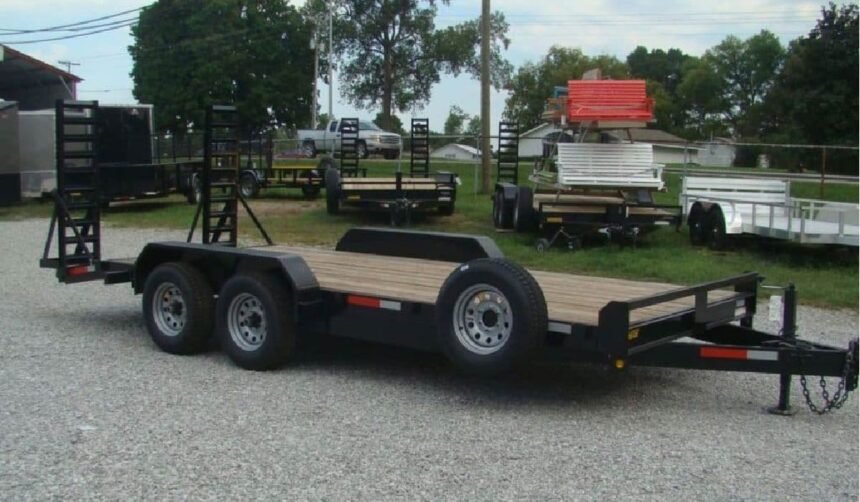
For many residents of the Flathead Valley, the “Montana Starter Pack” seems clear: you buy a truck, you buy some land, and eventually, you buy a trailer. Whether it’s a flatbed for the ATV, a cargo trailer for the move, or a dump trailer for the endless yard work, the impulse to own your hauling gear is strong. It feels like freedom. It feels like preparation.
But for the average homeowner who uses a trailer fewer than ten times a year, this purchase is rarely an asset. It is a liability that slowly disintegrates in your driveway.
In the unique climate of Northwest Montana—where summer brings intense high-altitude UV rays and winter brings sub-zero freezes and corrosive road de-icers—the economics of trailer ownership are often upside down. Before you drop $4,000 on a new utility trailer, it is time to audit the true cost of “Rent vs. Rot.”
The “Ghost Costs” of Ownership
The sticker price of a trailer is just the entry fee. The real cost comes from the friction of keeping it.
- The Real Estate Tax Kalispell is growing. As property values rise, the square footage of your driveway becomes more valuable. A standard 16-foot utility trailer takes up roughly 130 square feet of prime real estate. If you don’t have the land, you are forced into a storage facility.
In the Flathead Valley, outdoor storage for a trailer can range from $40 to $100 per month. Indoor storage—which is necessary to prevent the snow load from crushing the roof or rotting the deck—can easily exceed $150 a month. That is $1,800 a year just to house a piece of metal you might use three weekends a summer.
- The “Montana Salt” Factor If you drive your trailer between November and April, you are introducing it to its worst enemy: Magnesium Chloride. This liquid de-icer, used heavily on Montana highways, is stickier and more corrosive than traditional rock salt.
Unlike a modern truck, which is dipped in anti-corrosion baths at the factory, most utility trailers are painted with simple enamel or powder coats. Once the road spray hits the frame, the clock starts ticking. Wiring harnesses corrode, fender welds snap, and leaf springs rust frozen. Fighting this requires pressure washing the undercarriage in freezing temperatures—a chore most owners skip, leading to rapid depreciation.
The Silent Killer: Tire Dry Rot
Perhaps the most dangerous myth of trailer ownership is, “The tires look new, so they are safe.”
In a climate like Kalispell’s, tires rarely wear out from mileage; they die from age. Trailers often sit stationary for 90% of their life. When a tire sits in one spot, the anti-oxidant compounds in the rubber stop circulating. Combined with the UV exposure from the high-altitude sun, this causes “dry rot.”
A tire can look perfect on the outside but have a separating sidewall structure on the inside. A blowout on Highway 93 while towing a snowmobile isn’t just an inconvenience; it’s a major safety hazard. Rental fleets rotate their inventory constantly, meaning the tires are fresh. Private owners often find themselves replacing four “new looking” tires every four years—a $600 to $800 recurring expense.
The Rodent Tax
Ask anyone who has stored a trailer in a barn or field near Whitefish about the “Rodent Tax.” Mice and pack rats love trailer wiring. The insulation used on modern wiring harnesses is often soy-based, making it a delicious snack for wintering vermin.
You might hook up your truck for a spring dump run only to find that the lights are dead and the electric brakes are severed. Rewiring a trailer is expensive and frustrating. It is a maintenance headache that renters never have to touch.
The “One-Trick Pony” Problem
Finally, there is the issue of utility. Trailers are tools, and different jobs require different tools.
- The Dump Run: You need a hydraulic dump trailer to handle the volume and weight of brush or construction debris.
- The Car Haul: You need a flatbed with ramps and heavy-duty tie-downs.
- The Move: You need an enclosed cargo trailer to keep your furniture dry and secure.
If you buy a flatbed, you can’t easily haul loose gravel. If you buy an enclosed trailer, you can’t haul a tall tractor. Ownership locks you into a single capability. You end up trying to force the wrong tool to do the job—shoveling gravel out of the back of a horse trailer or trying to strap a couch to a flatbed in the rain.
The Rental Math
So, when does buying make sense? The math suggests the “Break-Even Point” is higher than most realize.
If a daily rental costs roughly $100, and the total cost of ownership (purchase amortization, registration, insurance, tires, maintenance, storage) averages $1,200 a year, you need to use that trailer at least 12 times a year—once every single month—just to break even.
For the vast majority of homeowners who do a spring clean-up, a fall harvest haul, and perhaps one or two furniture moves, the numbers don’t add up.
Conclusion
There is a specific kind of luxury in not owning things. There is value in walking away from the maintenance, the storage fees, and the rust.
By choosing to rent, you gain access to a fleet of specialized tools. You get the hydraulic dump trailer when you need to move dirt, and the enclosed cargo trailer when you need to move antiques. You get tires that are safe, lights that work, and a driveway that is empty.
For the residents of the Flathead, where the seasons are extreme and the terrain is demanding, the smartest move is often to let someone else handle the rust, while you handle the road. When the job is done, you simply drop it off—and drive away.
For those moments when you need the right tool for the job without the lifetime commitment, trailer rentals in Kalispell MT offer the flexibility that matches the Montana lifestyle: rugged, ready, and unburdened.