



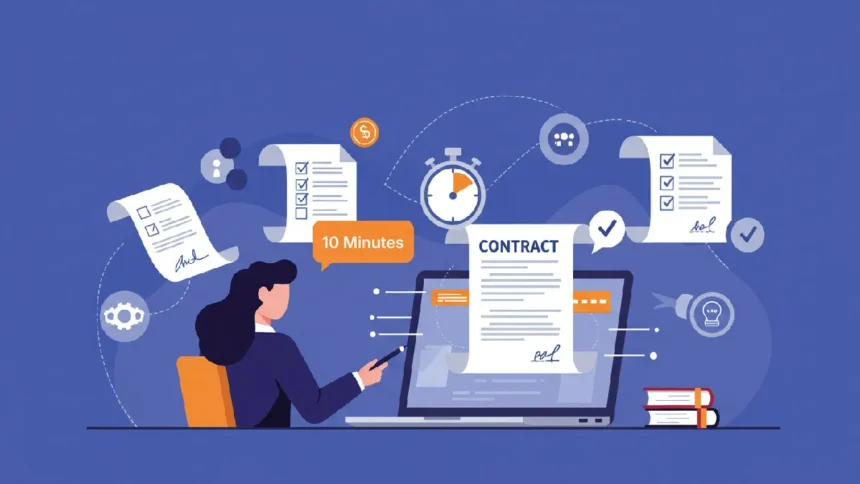
Contract review and analysis are among the most time-consuming tasks in legal practice. Whether it’s reviewing vendor agreements, employment contracts, NDAs, or complex commercial deals, lawyers must identify risks, ensure compliance, and protect client interests—often under tight deadlines.
Today, Legal AI is transforming how contracts are reviewed and analyzed. By combining artificial intelligence with legal expertise, Legal AI tools help legal professionals review contracts faster, more consistently, and with greater accuracy—without replacing professional judgment.
This step-by-step guide explains how to use Legal AI for contract review and analysis, from preparation to final approval, along with best practices and common pitfalls to avoid.
What Is Legal AI in Contract Review?
Legal AI for contract review refers to the use of artificial intelligence technologies—such as natural language processing (NLP) and machine learning—to analyze contracts and assist lawyers in identifying key clauses, risks, inconsistencies, and obligations.
Legal AI tools are designed to:
- Extract important clauses
- Flag non-standard or risky language
- Compare contracts against templates
- Improve review speed and consistency
The lawyer remains responsible for all final decisions.
Why Use Legal AI for Contract Review?
Traditional contract review is:
- Time-intensive
- Repetitive
- Prone to human oversight
Legal AI addresses these challenges by automating routine analysis while preserving accuracy and control.
Step 1: Prepare the Contract for Legal AI Review
Before using Legal AI, proper preparation is essential.
What to Do
- Ensure the contract is in a supported format (Word or PDF)
- Confirm the document is complete
- Remove unnecessary comments or drafts
Why It Matters
Clean input ensures more accurate Legal AI analysis and reduces false flags.
Step 2: Upload the Contract to a Legal AI Platform
Once prepared, upload the contract into your chosen Legal AI tool.
What Happens Behind the Scenes
Legal AI:
- Breaks the contract into sections
- Identifies clause boundaries
- Classifies provisions by type
This foundational step enables deeper analysis.
Step 3: Automated Clause Identification and Extraction
Legal AI scans the document to identify:
- Key clauses (termination, indemnity, liability, confidentiality)
- Obligations and rights
- Payment and renewal terms
This gives lawyers an instant overview of the contract structure.
Step 4: Risk Detection and Issue Flagging
One of the most powerful features of Legal AI is risk identification.
How Legal AI Flags Risks
Legal AI compares contract language against:
- Standard clause libraries
- Pre-approved templates
- Regulatory requirements
It flags:
- Missing clauses
- Unusual or non-standard language
- Potentially unfavorable terms
Step 5: Contract Comparison and Redlining
Legal AI allows lawyers to:
- Compare contracts against a “gold standard” template
- Identify deviations quickly
- Highlight differences at the clause level
This significantly speeds up redlining and negotiation preparation.
Step 6: Contextual Analysis and Legal Insight
Beyond surface-level review, advanced Legal AI provides:
- Contextual explanations of flagged clauses
- Risk severity indicators
- Suggested alternative language
These insights help lawyers prioritize issues efficiently.
Step 7: Compliance and Regulatory Review
Legal AI assists with compliance by:
- Flagging clauses that may violate regulations
- Highlighting jurisdiction-specific concerns
- Ensuring alignment with internal policies
This is especially valuable for highly regulated industries.
Step 8: Human Review and Legal Judgment
Despite automation, human review is essential.
Best Practice
- Validate all AI-flagged issues
- Apply legal judgment to business context
- Make final decisions manually
Legal AI supports—but does not replace—lawyers.
Step 9: Collaboration and Version Control
Legal AI platforms often include:
- Version comparison
- Change tracking
- Team collaboration features
This ensures efficient teamwork and auditability.
Step 10: Final Approval and Documentation
After review:
- Finalize revisions
- Export the approved contract
- Maintain audit trails if required
Legal AI helps ensure accuracy and consistency through the entire process.
Benefits of Using Legal AI for Contract Review
1. Speed and Efficiency
Review contracts in minutes instead of hours.
2. Consistency
Apply the same standards across all contracts.
3. Risk Reduction
Identify hidden risks early.
4. Cost Savings
Reduce time spent on repetitive review.
5. Scalability
Handle large contract volumes with ease.
Common Mistakes to Avoid When Using Legal AI
- Blindly trusting AI without review
- Using non-legal AI tools
- Ignoring jurisdictional nuances
- Failing to customize templates
Avoiding these mistakes ensures Legal AI adds real value.
Ethical and Confidentiality Considerations
Legal professionals must ensure:
- Client confidentiality
- Secure data handling
- Ethical compliance
Choose Legal AI platforms designed for professional legal use.
Legal AI vs Manual Contract Review
| Aspect | Manual Review | Legal AI Review |
| Speed | Slow | Fast |
| Consistency | Variable | High |
| Risk Detection | Manual | Automated |
| Scalability | Limited | High |
The best approach combines both.
The Future of Legal AI in Contract Analysis
Legal AI will continue evolving with:
- Predictive risk scoring
- Smarter clause recommendations
- Deeper integration with workflows
- Enhanced explainability
Contract review will become more proactive and strategic.