



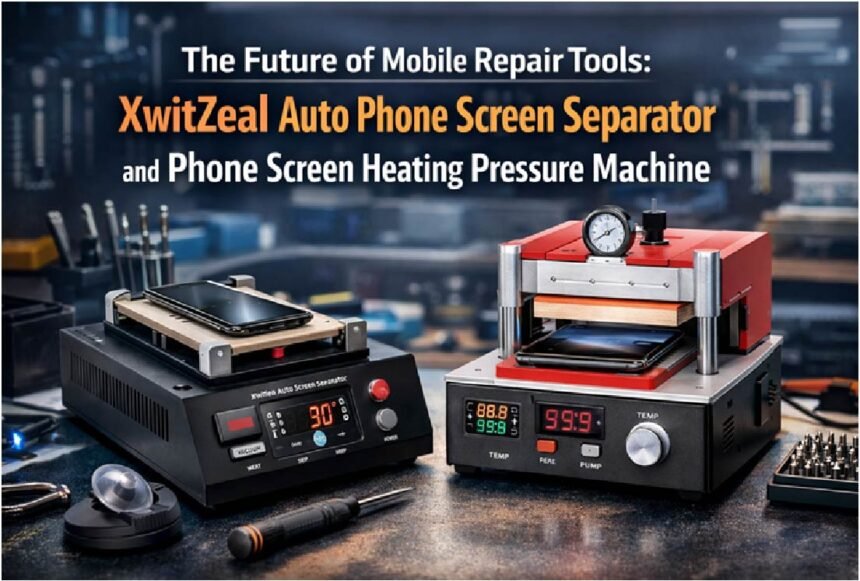
With the rapid pace of smartphone iterations, their internal structures have evolved from early modular designs to today’s extremely precise and tightly integrated architectures. In this context, the mobile phone repair industry is undergoing a tool revolution driven by intelligence, safety, and efficiency. Whether for DIY enthusiasts seeking a challenge or technicians operating professional repair shops, possessing precision repair tools capable of handling modern craftsmanship has become a prerequisite for survival.
- I. Understanding Mobile Phone Repair Tools
- 1. Evolution of Mobile Phone Repair Tools
The complexity of mobile phone repair has given birth to a new generation of advanced tools. Their core logic lies in:
- Precision Temperature Control and Physical Isolation: Avoiding permanent damage to OLED pixels or internal lithium batteries caused by high temperatures.
- Time Efficiency and Standardization: Standardizing complex disassembly processes to significantly shorten the repair time per unit.
- Zero–Risk Operation: Replacing pure manual intuition with mechanical assistance to reduce the risk of screen breakage caused by improper force control.
- 2. In-depth Analysis of Core Equipment
Screen damage is the most common fault in mobile phone repairs. When facing shattered glass or failed touch functions, the role of advanced equipment is irreplaceable.
- Phone Screen Heating Separator
- a. Vacuum Adsorption Technology: Utilizes a powerful built-in vacuum pump to firmly lock the device body.
- b. Controlled Heating: Precisely heats the frame adhesive to soften it at a critical point without damaging internal components.
- c. Intelligent Lifting: Smoothly separates the screen through lead screw micro-adjustments, completely eliminating the uneven pressure generated by manual prying.
- Phone Screen Heating and Pressure Machine
Separation is only the first step; refurbishment and restoration are the true tests. After replacing the cover glass, air bubbles and poor fitting are the biggest pain points.
- a. Non-bubbling Function: Forcibly expels tiny bubbles from the OCA glue through a high-pressure environment, ensuring the display is crystal clear.
- b. Constant Temperature Pressing: Ensures the sealant between the screen and the frame is heated uniformly, restoring factory-level waterproof performance and structural strength.
- II. Cell Phone Repair Process
To better understand the practical value of these phone tools, we take a typical “mobile phone outer glass replacement” as an example to analyze its standardized steps.
- 1. Preparation Phase
Before starting the repair, in addition to the core machinery, you also need to prepare the following auxiliary tools:
- Screw Storage Box: Used to classify and store screws of different specifications and lengths.
- Anti–static Gloves and Wrist Straps: To prevent human static electricity from breaking down tiny capacitors.
- Cutting Wire: Used to separate the LCD layer from the broken glass.
- Adhesive Remover and Microfiber Cloth: Used for cleaning residual glue.
- 2. Repair Steps
Step1. Diagnosis and Functional Check
Test whether the touch is sensitive and if there are black spots on the display. If the LCD layer is intact and only the glass is cracked, it is suitable for “cover plate replacement” refurbishment.
Step2. Precision Separation
Place the phone on the XwitZeal CP1 Screen Separator Removal Machine. Set the temperature to 80°C and activate the vacuum adsorption. Once the adhesive is sensed to have weakened, the machine automatically separates at a uniform speed. This process avoids secondary damage caused by glass fragments piercing the LCD layer during manual disassembly.
Step3. Residual Glue Treatment and LCD Cleaning
Using the heating platform for assistance, apply a dedicated adhesive remover and use a glue removal scraper to gently scrape off the old glue. Finally, use a lint-free cloth dipped in alcohol to clean thoroughly, ensuring no dust or grease residue remains.
Step4. Lamination and Pressure Restoration
In a dust-free laboratory environment, align the new cover plate with the LCD. Then, place it into the heating and pressure machine. Set a constant air pressure and temperature for a cycle of several minutes.
Step5. Reassembly and Final Quality Inspection
Reinstall the screen assembly into the body. Use a torque screwdriver to tighten screws according to standard force, avoiding excessive pressure on the internal screen. Finally, conduct a full functional test, including proximity and ambient light sensors.
III. Industry Trends and Value Gains
The popularization of modern repair tools is redefining the “phone repair” business.
- 1. For DIY Users and Beginners
In the past, high barriers to entry made it difficult for average users to take the first step. Now, automated equipment compensates for a lack of experience through technical means, reducing the risk of errors and allowing individual users to experience the achievement of professional repair at home.
- 2. For Professional Repair Shops and Enterprises
- Increased Output: Standardized processes mean multiple machines can be repaired simultaneously, increasing daily throughput.
- Customer Trust: Professional equipment displays serve as a technical endorsement, significantly reducing compensation disputes caused by human error.
- Sustainability: Supporting screen refurbishment rather than simply replacing expensive original assemblies saves money for customers and reduces electronic waste.
- IV. Expert Advice
If you plan to upgrade or open a new repair center, you should follow these principles when choosing tools:
Compatibility First: Ensure that separators and pressure machines can support various curved or flat screen models ranging from 5 inches to 7 inches.
Safety Protection Mechanisms: Machines must be equipped with overheat protection and emergency stop functions to prevent battery fires in extreme situations.
Continuous Maintenance: Regularly clean the vacuum pump filters and calibrate the actual temperature of the heating platform against the displayed temperature.
Conclusion
The quality of Mobile phone repair tools directly determines the efficiency and standard of repairs. Configuring standardized equipment is not a simple expense but a necessary investment to elevate technical standards. Investing in professional equipment is a strategic necessity.