



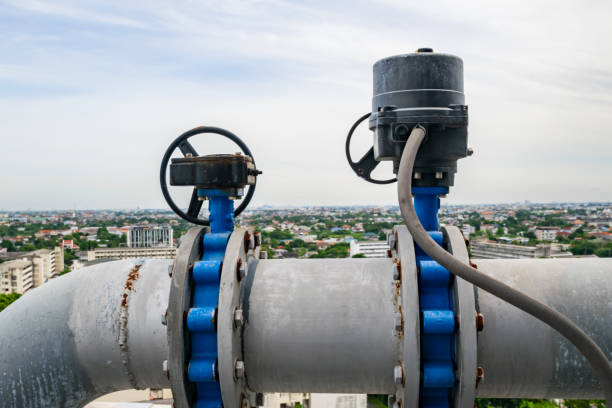
Motorized butterfly valves and electric actuated butterfly valves differ fundamentally in scope and application. Which one works best for a particular use context would depend on operational needs and strategic value for a business. Apart from divergences in scope, each option has unique strengths. In the context of business-to-business interactions and sourcing from control valves manufacturers dealers, knowledge of each valued feature is essential. The advantages of both options will be the focus of this write-up.
Motorized butterfly valves are butterfly valves fitted with a motor. The motor is the power source and ‘drives’ the valve clock and counter-clockwise, effectively opening and closing the valve. The rotational power is sufficient to actuate control of fluid flow. Motorized butterfly valves are most commonly used in on-off and cost- flow regulation applications.
These valves come in different configurations, including options with a manual override, and suit applications where automation or remote operation is required. In industries like HVAC, water treatment, and chemical processing, motorized butterfly valves are common because they provide fast and dependable flow control.
What are electric actuated butterfly valves?
Electric actuated butterfly valves integrate a butterfly valve and an electric actuator, which delivers precise flow control and automation. As an electric actuator adjusts a valve position, electric control allows for fine, smooth, and accurate flow about the valve. Beyond motorized butterfly valves, electric actuated butterfly valves include control features like feedback loops, position indicators, and remote monitoring which enhance control functionality.
These valves are used in complex industrial applications where precise control and advanced functionality are required, especially in automated systems. For instance, the oil and gas sector, the power generation sector, and chemical manufacturing rely on the precision and high automation offered by electric actuated butterfly valves.
Basic Differences Between Motorized and Electric Butterfly Valves
1. Control and Precision
Motorized butterfly valves work best when only basic on/off flow control is required in an application. Motorized mechanisms do provide dependable actuation; however, they lack the precision associated with the electric actuated butterfly valves. In contrast, electric actuated butterfly valves are designed for precision and thus, are used in applications where control, regulation, and positioning of flow is critical.
Formally, simply activated electric motors do not provide control precision. Their valves control outputs with high precision. This is needed for industries where flow control and regulation is constant for observation.
2. Actuation Method
The difference between these two valves mainly comes to their actuation method. Motorized butterfly valves simply have a motor disc that only provides clockwise rotation and thus the butterfly simply opens or closes. In contrast, electric actuated butterfly valves utilize an electric actuator providing much more flexibility through a range of controlled positions. This difference provides a higher tier range of systems for electric actuated butterfly valves for automated systems and flow that needs to be continuously transformed.
3. Automation and Integration
Electric actuated butterfly valves provide more advanced options when it comes to automation and integration. They are designed for inclusion within automated control systems, enabling automated control and monitoring from a distance. Electric actuators typically have advanced automation functionalities, such as position feedback, fail-safe control, and SCADA or DCS interface capabilities.
Motorized butterfly valves can be integrated into automated control systems, but the degree of sophistication and integration features is quite basic. They are more appropriate for rudimentary applications where automation and systems integration are not essential.
4. Energy Efficiency
Motorized butterfly valves are more energy-efficient, particularly in basic applications where the control is simply on and off. Electric actuated butterfly valves are still energy-efficient, but their advanced automation features may result in higher power consumption owing to the precision control demands of the application.
For businesses aiming to control energy use, the motorized butterfly valves are likely to provide a more cost-effective option for basic flow control applications.
5. Maintenance and Durability
In terms of durability and long-term performance, both types of valves have a different set of maintenance activities. Motorized butterfly valves tend to require less maintenance because their design includes fewer moving parts and less complex control mechanisms. For industries where applications involve simple flow control, the reliability of motorized butterfly valves makes them a low-maintenance option.
In contrast, the complex control systems and actuators of electric actuated butterfly valves require a greater maintenance commitment. Without a doubt, the controlled automation afforded by such valves makes them irreproachable in sophisticated applications where precision control is essential.
Applications of Motorized Butterfly Valves
Motorized butterfly valves have a diverse range of applications, particularly where reliability, simplicity, and cost-effectiveness are the primary values. Common examples are listed below:
- HVAC Systems: Motorized butterfly valves are used to control the flow of air and water in heating, ventilation, and air conditioning systems.
- Water Treatment Plants: Motorized butterfly valves provide efficient flow control in water treatment facilities for both potable water and wastewater.
- Chemical Processing: Motorized butterfly valves in chemical plants provide basic on/off control for the flow of liquids and chemicals for processing.
- Irrigation in Agriculture: These valves are used in agriculture to control the flow of water in irrigation systems.
Uses of Electric Actuated Butterfly Valves
Electric actuated butterfly valves are more suitable for intricate tasks requiring high precision. The following industries are examples of such uses:
- Industry of Oil and Gas: These valves adjust and control the flow and pressure to guarantee the safe use of oil and gas distribution.
- Industry of Power Generation: Electric actuated butterfly valves are used in power plant processes to guarantee safety and efficiency in the regulation of gas and steam.
- Chemical Industry: These valves are used in the control of the flow of chemicals in chemical manufacturing under various safe processing conditions to ensure safe processing.
- Industry of Food and Beverage: In the food and beverage sector, electric actuated butterfly valves are utilized for safe and sanitary flow regulation in production lines, to ensure reliable and safe processing.
- Choice of the Right Valve for Your application:
When B2B companies are evaluating motorized and electric actuated butterfly valves, these factors are to be considered:
- Control Required: Electric actuated butterfly valves are most suitable for control functions that require integration of automated systems and systems.
- Application Complexity: Choosing motorized butterfly valves can be an optimal choice for flow control applications that do not require complex solutions for control flow.
- Considerations for Energy Efficiency: Basic applications can utilize motorized butterfly valves and achieve energy efficiency, but for precise control, power consumption will increase for electric actuated butterfly valves.
- Maintenance and Costs: In terms of economic value and minimal maintenance, motorized butterfly valves would be optimal for cost-sensitive industries that only require basic flow control.
Conclusion
There are distinct merits for different industrial applications depending on the type of control the system requires. For simpler applications needing on/off control, motorized butterfly valves are suited for the task. More complex and automated systems require the electric actuated butterfly valves which can offer precise control. The flow control needs and the control level are critical factors for businesses with these two options.
Working with reputable control valve manufacturers allows businesses to gain the corresponding valve solution which not only integrates the right technology but also aligns with the cost parameters, maximizing the efficiency and effectiveness of the system.