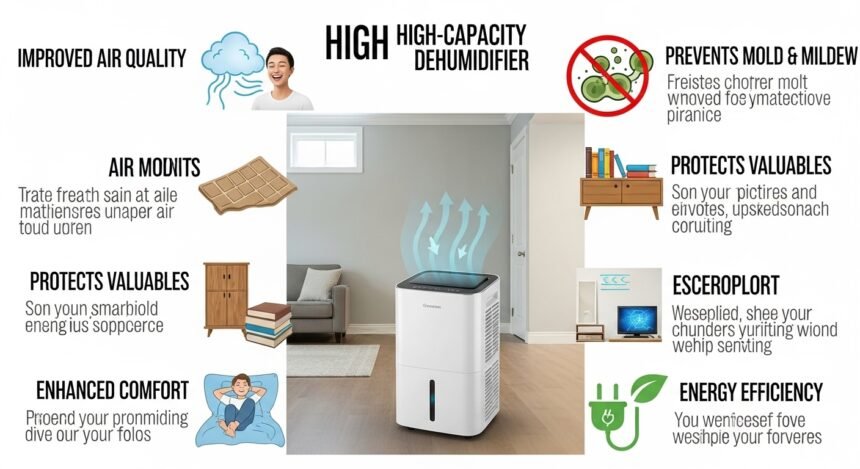
You know the feeling. That smell of mildew that haunts your basement. The foggy windows in your bedroom. That feeling your clothes have when you take them out of the closet – kind of damp, even after weeks of sitting there. It might be time for a dehumidifier.
Should You Buy A High-Capacity Dehumidifier?
In particular, should you spend extra money on a high-capacity model? That’s what we’re here to discuss.
What is considered a high capacity dehumidifier anyway?
Let’s start with that term – “high capacity.” Generally, when we’re talking about a “high capacity” dehumidifier we mean a unit that extracts 50-70 pints of water from the air every day. Some commercial grade models offer 90+ capacity. Smaller models typically fall in the 20-30 range.
The Cost of Humidity
All of these problems cost you money. High humidity levels make your AC work overtime. Your air conditioner doesn’t just cool the air in your home – it extracts water from the air. When the humidity in your home is already high, your AC has to work twice as hard to make your home comfortable. Translation: higher energy bills.
Moisture also ruins your stuff. Wood warps. Metal rusts. Books and pictures grow mold. You can even ruin electronics by exposing them to too much humidity.
Most importantly, humidity can harm your health. Dust mites and mold love humidity. These allergens can cause asthma attacks, allergies, and respiratory issues. Nobody should have to worry about what’s floating in the air when they spend time in their own home.
Who Needs High Capacity?
High capacity isn’t for everybody. If you have a small room with an occasional moisture problem, you can get away with a small dehumidifier without much trouble.
However, a couple of factors tell you need to go bigger. How much space will your dehumidifier need to cover? High capacity machines are ideal for rooms larger than 1,500 square feet. This includes most basements, entire floors of your home, and open-concept living spaces.
You also need more power if you have serious moisture problems. Do you live in a naturally humid climate (ahem, Houston)? Do you get occasional basement flooding? Is your crawl space damp all year long? If so, a low capacity unit will run all the time and struggle to keep up with moisture levels.
Eventually your small dehumidifier will wear down more quickly from being overworked. Plus, you’ll still be running up your electric bill because it can’t do the job quickly!
The Savings of Going High Capacity
Now we get to the best part. High capacity dehumidifiers cost more money. You’ll spend $200-$400 on a good unit. However, that investment will pay for itself. High capacity machines simply do not run as long as smaller ones. Because they can extract more moisture at a time, they quickly bring down humidity levels and shut off. A small unit will run constantly and still feel like it can’t keep up.
Not only will you save money on electricity, but you’ll save money on replacements. A medium capacity dehumidifier running at half speed will never last as long as a high capacity unit running on low.
And let’s not forget about the money you’ll save by protecting your house and belongings. Avoiding mold remediation alone can save you several thousand dollars. Mold removal costs anywhere from $500 to $6,000 depending on how severe the problem is. Wood rot, structural damage, and ruined furniture and possessions can increase that price dramatically.
Higher Capacity = Bigger Benefits
Bigger dehumidifiers usually come with better features. And features you’ll use. Most have built-in pumps. That means there’s no bucket to empty. Your unit pumps water out of a hose either through a drain or out a window. No more fussing with buckets of water and spills.
Many include better humidity controls as well. You can set your desired humidity level, and the machine maintains that level automatically. You can even find smart units that allow you to monitor and control via an app on your smartphone. Air filters are higher quality too. You’re not just removing excess moisture from the air, you’re cleaning it.
Efficiency Is Energy Efficiency
Sure, a larger dehumidifier uses more electricity. Right out of the package? Yes. However, have you seen the Energy Star ratings on modern high capacity dehumidifiers? These things are efficient. In order to meet the requirements for Energy Star qualification, they have to remove more water per watt of electricity than older models.
Plus, when you go with one large unit over multiple small ones you’re already saving energy. Two small dehumidifiers use more total energy and cost more to purchase and maintain than one correctly-sized high capacity alternative.
It Just Feels Better
Okay so we covered the science. But how does it feel to live in a properly dehumidified home? Your skin doesn’t feel sticky. Your sheets don’t cling uncomfortably to you at night. Your home smells fresh rather than musty. You sleep better because the air feels less heavy.
When you live comfortably in your home, you enjoy a better quality of life. Invite people over without worrying about the way your house smells. Spend less time battling allergies. Feel relaxed in your own home.
Buy Right For Your Home
Before you go out and buy a dehumidifier, make sure you get one that suits your needs. Measure the square footage of the area you need to cover. Look up your home’s humidity levels with an affordable hygrometer. Ideally you want to keep your indoor humidity between 30%-50%.
Take measures of where you plan to put your unit. This means making sure you have proper drainage and good airflow. You’ll need about two feet of clearance on all sides of most high capacity models.
Check pint-per-day capacity against your square footage. Dehumidifier manufacturers usually provide a handy chart with recommended BTU capacity for various room sizes at different humidity levels.
Case Study: Real UK Dehumidifier Trial Confirms They Solve Condensation & Boost Comfort
Recently researchers conducted what’s known as a “blind” trial to gather real world evidence on how well high-capacity dehumidifiers solve moisture problems.
They installed a machine in a British home for the winter season and tested how it performed over 28 nights.
Results? Check out these quotes pulled straight from the published study:
“The average daily removal of water vapor was 680 ml per day…”
“The amount of condensation decreased significantly…”
“The room felt less humid…”
“A drop in temperature compensated for the latent heat extracted from the room…”
Review of full study: Solving mould and condensation problems: A dehumidifier trial in a suburban house in Britain – https://www.econstor.eu/obitstream/10419/48795/1/626009278.pdf
One thing these results clearly demonstrate is that when properly sized for the space, a dehumidifier can actually lower visible signs of condensation on walls and windows. It also indirectly helps reduce moisture damage risks while making rooms feel more comfortable. NHS told us that is why investing in a large-capacity model for damp basements, laundry rooms or even whole floors will almost always provide much more benefit than opting for an undersized machine.
High-Capacity Dehumidifier FAQs
What qualifies as a high capacity dehumidifier?
Dehumidifiers that can collect 50–70 pints (23-33 litres) of water per day are considered high-capacity. Some home-level units can even extract over 90 pints daily. The higher the better when it comes to tackling larger spaces or more serious humidity problems.
Will I need one for my home?
If your basement or room is >1,500 sq ft or suffers from chronic dampness like standing water puddles, dripping walls and windows, then upgrading to a larger dehumidifier makes sense. Lower capacity models have to run 24/7 just to keep up in spaces that size or humidity level.
Do they really help eliminate mold and condensation?
Yes! Real world testing has shown that by removing significant amounts of moisture from the air, high capacity dehumidifiers can completely eliminate condensation on windows and dramatically reduce mold growth. This naturally leads to more comfortable rooms and improved indoor air quality year-round, even during colder months.
Are they energy efficient?
High-capacity units these days are usually ENERGY STAR certified. That means they efficiently remove more water vapour per watt of electricity compared to older models. Because they work faster at dehumidifying a room and only run when necessary (versus small units which may run constantly), high capacity models can actually end up consuming less power.
What humidity level should I try to maintain?
The ideal range for indoor humidity is anywhere between 30-50%. Anything higher could encourage mold, dust mites and allergies. Some people find lowering it too far can cause dry skin and other respiratory issues though.
Are they more expensive to run?
While the initial cost is higher (£200-£400+), high capacity models often have a lower lifetime energy cost since they can reach desired humidity levels faster and don’t need to run continuously like multiple smaller units would.
Are there any special features I should look for?
Look for models with built-in pumps to avoid emptying buckets, humidity sensors to constantly keep levels in set range, and smart features like app connectivity or timers. Higher capacity doesn’t have to mean inconvenience — these features can really help.
Will I really notice a difference in comfort?
You might be surprised! Many users find their air feels less stuffy when running a dehumidifier. Mould odours go away, laundry and towels dry quicker, and some even say their heating systems seem to work better at lower humidity levels.