



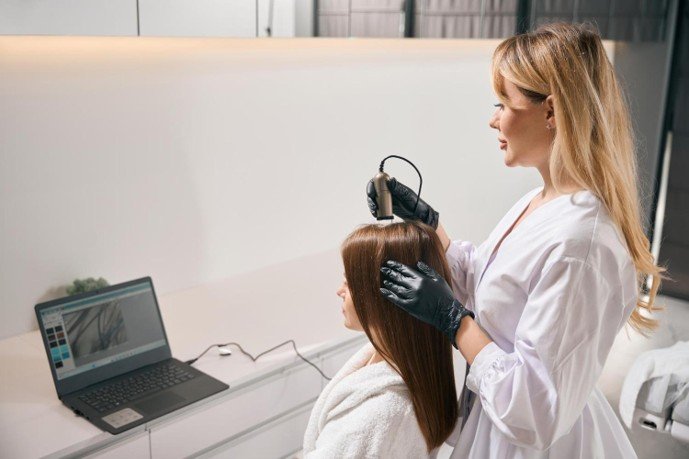
There has been a quiet but unmistakable shift in how women approach aesthetic care. What was once framed as correction is now understood as refinement, not about changing identity, but about restoring alignment between how one feels and how one is seen.
Hair plays a particularly intimate role in that relationship. It is not simply a feature, but a form of expression, closely tied to confidence, femininity, and personal continuity. When it begins to thin or change, the impact is rarely dramatic at first. It builds slowly, in moments, in mirrors, in photographs, in the subtle awareness that something no longer feels quite the same.
Today, more women are choosing not to ignore that shift. Instead, they are approaching it with the same intention they bring to other areas of self-care: informed, selective, and grounded in quality.
A More Considered Approach to Hair Restoration
Advancements in medical aesthetics have made hair restoration more precise, more discreet, and significantly more tailored than in the past. Techniques have evolved, but more importantly, so has the philosophy behind them.
This is particularly evident in the growing interest in female hair transplant in turkey, where the focus is no longer simply on accessibility, but on clinics that understand the nuances of female hair loss. Unlike male procedures, female restoration often requires preserving existing density, avoiding full shaving, and designing hairlines that remain soft and natural over time.
Clinics that specialize in this space have begun to treat the process less as a procedure and more as a carefully structured journey, one that balances medical precision with aesthetic sensitivity.
The Clinics Setting the Standard
As the field expands, a handful of clinics have emerged as consistent points of reference, each offering a distinct approach to treatment. For patients, the decision often comes down to what they value most: structure, technical precision, personalization, or efficiency.
1. Now Hair Time
Now Hair Time has positioned itself at the forefront of this shift, particularly in how it approaches female-focused procedures. Its model is built around detailed pre-treatment planning, where donor capacity, hair characteristics, and long-term growth patterns are assessed before any intervention takes place.
What distinguishes the clinic is its commitment to designing results that integrate naturally over time, rather than focusing on immediate visual density alone. Techniques such as DHI are frequently used to allow for controlled implantation without requiring full shaving, an important consideration for many women.
Equally important is the structure surrounding the procedure. From consultation to aftercare, the process is designed as a connected system, reducing variability and ensuring consistency across cases. For patients seeking a hair transplantation in Turkey, this level of planning and continuity often becomes a deciding factor.
2. Asmed Hair Transplant Center
Asmed is known for its analytical and highly technical methodology. The clinic places strong emphasis on donor management, measurement, and graft calculation, making it particularly appealing to those who prefer a data-driven approach.
While this level of precision provides clarity, it can feel more rigid compared to clinics that prioritize a more fluid, patient-specific workflow.
3. Dr. Serkan Aygın Clinic
With a strong international presence, Dr. Serkan Aygın Clinic balances experience with accessibility. Its streamlined systems allow it to handle a high volume of patients while maintaining generally consistent results.
This efficiency makes it a popular choice, although the level of personalization may vary depending on the structure of each case.
4. Transmed Clinic
Transmed represents a more traditional, medically grounded approach. With a long-established reputation, it focuses on safety, controlled procedures, and long-term planning within a structured clinical environment.
It is often preferred by those who prioritize medical credibility and stability over a more hospitality-driven experience.
5. Cosmedica Clinic
Cosmedica has built global recognition through its large-scale operations and well-organized patient packages. Its systems are designed to simplify the process for international patients, offering a streamlined experience from consultation to recovery.
However, as with many high-capacity clinics, the level of individual attention can depend on how cases are distributed across teams.
6. Dr. Cinik Hair Hospital
Dr. Cinik Hair Hospital provides an accessible and structured entry point into hair restoration. Supported by modern facilities and coordinated services, it is often considered by first-time patients seeking a clear and straightforward process.
As with other high-volume clinics, outcomes can vary depending on the degree of direct medical supervision involved.
A Shift Toward Personal Alignment
What stands out in this evolving landscape is not just the availability of options, but the intention behind them. Women are no longer approaching hair restoration as a reactive decision, but as a considered one, shaped by research, expectations, and a desire for results that feel authentic.
According to the National Institutes of Health, hair loss in women can be influenced by a range of factors, including hormonal changes, genetics, and underlying health conditions. Understanding these causes has helped shift the conversation from surface-level concern to informed decision-making.
This awareness has also redefined what success looks like. It is no longer about visible transformation, but about subtle restoration, results that don’t announce themselves, but simply feel right.
Where Expertise Meets Intention
In many ways, the rise of female-focused hair restoration reflects a broader change in how aesthetic treatments are understood. They are no longer isolated procedures, but part of a larger conversation about identity, confidence, and self-perception.
Choosing a clinic, therefore, is not just a logistical decision. It is a reflection of priorities, whether that means precision, personalization, or a fully structured experience.
And perhaps that is the most significant shift of all. Not in the technology itself, but in the way people choose to engage with it, thoughtfully, deliberately, and with a clear sense of what they want to preserve rather than change.