



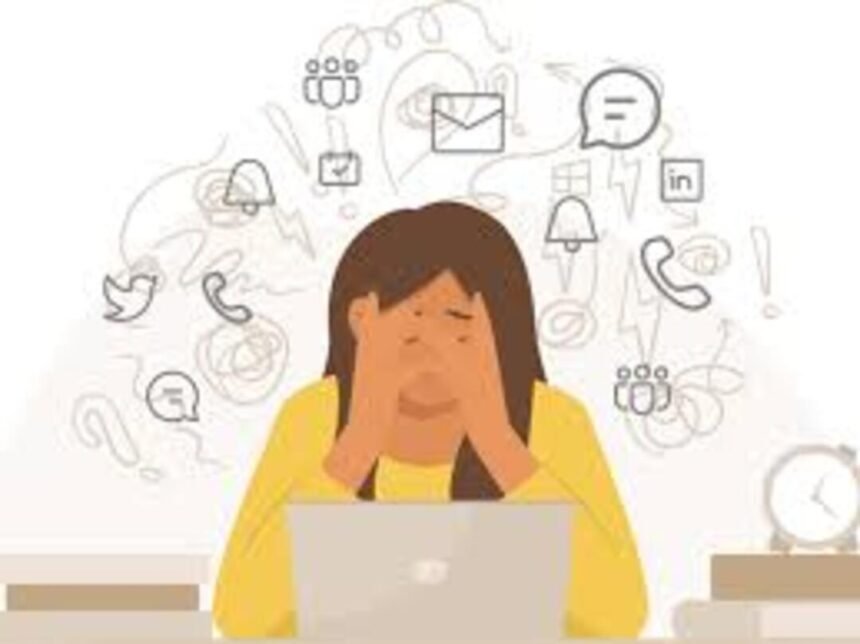
You don’t notice it happening. That’s the problem.
You open your phone for something small. A reply. A quick check. A tiny break between tasks. Then you look up and realise you’ve been scrolling for twenty minutes, your shoulders are tense, and your brain feels loud. Not loud like a party. Loud like a crowded train when you’re already tired.
For Gen Z and millennials in Britain, this kind of low-grade digital overload has become normal. Social media is where your friends are, where the news breaks, where work trends live, where you find a flat, where you learn what people are wearing, eating, buying, and feeling. It’s not a separate activity anymore. It’s a background layer.
And yet, more people are saying the same thing in different ways: “I can’t switch off.” “I’m more anxious.” “My sleep is terrible.” “I feel behind.” “I don’t even enjoy the apps, but I keep opening them.”
So, is social media quietly damaging mental health? For many people, yes. Not because you’re weak, and not because you “lack discipline.” It’s because the system is built to keep you engaged, and your nervous system pays the bill.
The attention economy isn’t neutral
Most platforms don’t run on your happiness. They run on your time. The more you stay, the more you see, the more ads they serve, the more data they collect, the more they can keep you coming back. That business model shapes everything: the endless feed, autoplay videos, push notifications, “recommended for you,” and the way controversy seems to travel faster than calm.
It’s a bit like working in a company where every meeting is marked “urgent.” Eventually, you stop trusting the word. But your body still reacts. Your stress response can’t tell the difference between a real emergency and a constant drip of urgent content.
And because social media is always available, it can swallow the quiet moments that used to reset you. The bus ride. The queue at Tesco. The walk to the tube. The “nothing time” is when your brain processes life. Now those gaps get filled with input. More content, more faces, more opinions, more comparisons.
That’s not harmless.
Anxiety: when your mind never fully clocks off
Anxiety linked to social media doesn’t always look dramatic. It often looks like a background tab you can’t close.
You scroll and feel tense, but you keep going. You read one worrying headline, then another. You see someone’s holiday photos, then think about money. You watch a perfect relationship video, then start questioning your own. You absorb a stream of micro-stress, and your body treats it like a real threat.
There are a few common drivers.
One is information overload. You’re exposed to more distressing content in a week than people used to see in a year. Another is comparison. Even if you know it’s curated, your brain still reacts to it as a social ranking. Humans are wired for belonging. Social media turns belonging into a scoreboard.
Then there’s the subtle performance pressure. Not even influencer-level pressure, just the sense that you’re being perceived. Posting the right thing. Responding quickly. Staying in the loop. Having a take. Not missing out.
Sometimes people say, “But it’s just an app.” And yes, it’s an app. But the emotions it triggers are very real.
If you want a quick reality check, notice your body after ten minutes of scrolling. Is your jaw tight? Are you holding your breath? Does your chest feel slightly buzzy? That’s not imagination. That’s your nervous system reacting to stimulation, uncertainty, and social evaluation, all at once.
Sleep: the damage you feel the next day
Sleep is where digital overload becomes impossible to ignore.
The obvious issue is time. You meant to be in bed at 11, and suddenly it’s 1. That alone can throw off your mood and focus the next day. But there’s more going on than staying up late.
Your phone not only delays sleep. It changes the state your brain is in before you try to sleep. Scrolling keeps you alert. It keeps you emotionally activated. It gives you novelty when your brain needs boredom. And if you’re watching stressful content or reading arguments, your body can’t just flip into rest mode because you decided it’s bedtime.
People often describe it like this: “I’m exhausted, but my mind is racing.” That’s a classic sign you’re physically tired but mentally over-stimulated.
And when sleep drops, everything else gets harder. Anxiety rises. Irritability rises. Cravings rise. Your ability to regulate emotions drops. The small problems feel big. You’re less patient with your partner, your friends, and your colleagues. You feel more fragile. Then you scroll more because you’re tired and you want an easy distraction. The loop closes.
This is why a lot of “digital detox” advice fails. It focuses on screen time numbers, but not on the brain state you’re creating, especially at night.
Self-esteem: the quiet erosion effect
Even when social media doesn’t make you anxious, it can still chip away at self-esteem.
It’s not only about looks, though that’s part of it. It’s also the constant exposure to curated success. Better jobs. Better flats. Better bodies. Better relationships. Better weekends. Better skin. Better habits. People post wins, not the messy middle.
If you’re a millennial in Britain juggling work stress, high rent, and the cost of living, that content can land like a personal insult, even when it’s not meant that way. If you’re Gen Z dealing with exams, early career pressure, and the weirdness of growing up online, it can make normal life feel “not enough.”
There’s also the “always watched” feeling. You start seeing yourself through an external lens. How you look in photos. How does your life seem? Whether you’re interested. Whether you’re doing enough. It’s like living with a constant imaginary audience, and that can make you self-conscious in moments that should be simple.
And the hard part is that it sneaks in. You can think you’re fine and still find yourself feeling worse after you scroll. That mood drop is data. It matters.
A practical detox that doesn’t mean quitting
Here’s where people get stuck. They don’t want to quit completely, and they shouldn’t have to. Social media can be useful. It can be a community. It can be support. It can be entertainment. It can even be work.
But “useful” and “harmful” can exist at the same time. That’s the contradiction many people live with. And you can work with that reality instead of pretending it’s all good or all bad.
A practical detox is less about deleting apps and more about changing the way you interact with them. Think of it like tightening the boundaries around a job that keeps spilling into your evenings. You’re not leaving the job. You’re stopping it from owning your whole day.
Start with one goal: reduce the automatic checking. Automatic behaviour is what creates that drained, foggy feeling.
A few changes tend to help quickly:
First, remove the triggers. Turn off most notifications. Keep the ones that are genuinely important, like calls or texts. But do you need a ping every time someone likes a post or replies to a story? Most people don’t.
Second, add friction. Move your social apps off your home screen. Put them in a folder you have to search for. It sounds small, but it breaks the reflex. You go from “i opened it without thinking” to “i chose to open it,” and that choice gives you control back.
Third, protect your sleep like it’s a non-negotiable meeting. A simple rule works better than a complex plan. For example, no feed apps in bed. If that feels too strict, make it “no feeds after i get under the duvet.” The goal is not perfection. It’s reducing stimulation where it hurts most.
And if you notice your scrolling has become tied to mood, stress, or compulsive patterns, it can help to speak with professionals who work with behaviour and mental health, like Kora Behavioral Health. That isn’t a dramatic step. It’s support. It’s like getting help for sleep issues before they become burnout.
When digital overload is covering something deeper
Sometimes the issue isn’t the app. It’s what the app is doing for you.
People scroll to soothe. To avoid. To numb. To fill the silence. To escape a rough patch. To quiet anxious thoughts. To delay a hard task. To avoid loneliness. Social media becomes a coping mechanism that doesn’t look like one, which makes it easy to ignore.
If you recognise that pattern, be honest with yourself without turning it into self-criticism. Ask a basic question: what do i reach for my phone to avoid feeling?
That question can change things. Because once you see what the scrolling is doing, you can find healthier substitutes. Not perfect substitutes, just better ones.
And for some people, digital overload sits alongside other struggles like substance use, compulsive behaviours, or mental health crises. If that’s part of your life, structured support matters. In more acute cases, medical support can be essential, and services like Drug Detox in WA exist for people who need a safer reset with professional care.
That link isn’t for everyone. But the wider point applies to all of us: you don’t have to wait until you’re falling apart to get help.
How to keep social media without letting it run your life
The healthiest relationship with social media is often boring, and that’s a good sign.
It looks like checking it at certain times, then moving on. It looks like the following accounts make you feel calmer or smarter, not worse. It looks like unfollowing people who trigger comparison, even if you like them. It looks like curating your feed is like curating your workspace. You don’t decorate your office with things that make you feel rubbish. Your feed deserves the same respect.
It also helps to separate “creator mode” from “consumer mode.” If you post for work, schedule it. Post, respond to key messages, then log off. Don’t post and then scroll for an hour because the app keeps you there. That’s like sending an email and then sitting in your inbox, refreshing for a response all afternoon.
One more thing that sounds too simple but works: bring boredom back. Boredom gets a bad reputation, but it’s where your brain resets, processes emotions, and forms ideas. If every quiet moment gets filled with content, you lose that mental breathing space. And then you feel more anxious, even when nothing is wrong.
So no, you don’t need to quit social media entirely. You need boundaries that match how powerful these platforms are.
Because digital overload rarely ruins your mental health in one big moment. It wears you down in small, daily ways, until you forget what calm feels like.
And you deserve to remember.