



For over a decade, I have crisscrossed the globe covering the latest consumer electronics. My carry-on bag has always been a battleground for space.
I used to pack a heavy laptop, a tablet for movies, and noise-canceling headphones. It was a heavy, cumbersome setup that left me with a sore back and limited legroom.
Recently, however, I swapped the tablet and the laptop for something much lighter. The era of wearable displays has arrived, and it has completely changed how I endure long-haul flights.
The Evolution of Travel Entertainment
We have all experienced the “tech neck” phenomenon. You are stuck in a cramped economy seat, looking down at a phone screen for hours. It is physically exhausting.
The alternative is the seat-back screen. These are often dim, low-resolution, and unresponsive. They simply cannot do justice to modern cinema or high-definition gaming.
This is where the new wave of Smart Glasses comes into play. They promise to solve the physical discomfort of looking down by placing the screen directly in your line of sight.
Unlike VR headsets, which are bulky and isolate you completely, smart glasses are lightweight. They look like oversized sunglasses but hide sophisticated projection technology inside.
As the market for smart glasses matures, we are seeing a shift from novelty to utility. They are no longer just for early adopters; they are for anyone who values efficiency and comfort.
Entering the Era of Pocket Cinemas
The concept is simple but revolutionary. Imagine having a 201-inch TV screen that fits inside your pocket. That is the promise of modern AR eyewear.
After testing numerous models, I found the RayNeo Air 3s Pro AR Glasses to be a standout performer. They manage to balance image quality with legitimate wearability.
When you put on the RayNeo Air 3s Pro AR Glasses, the chaos of the airplane cabin disappears. You are immediately transported to a personal theater.
The screen appears to float about six meters in front of you. It is immersive, yet you maintain enough peripheral vision to grab your drink without spilling it.
For a frequent flyer, this device is a game-changer. It reclaims your personal space in an environment designed to take it away.
Visual Fidelity: It Is All About the OLED
The most critical spec for any display is the panel quality. If the image looks washed out, the immersion breaks immediately.
The RayNeo Air 3s Pro AR Glasses utilize RayNeo’s HueView 2.0 optical engine built around a 5.5th-gen tandem Micro-OLED display. This is the gold standard for near-eye displays today.
These smart glasses deliver a 1080p resolution per eye. While that might sound standard for a TV, at this proximity, the pixel density is incredibly high.
Understanding the Specs
- Contrast Ratio: The Micro-OLEDs offer deep, inky blacks that LCDs cannot match, with a rated contrast ratio up to 200,000:1.
- Refresh Rate: A smooth up to 120Hz refresh rate makes gaming and action movies fluid.
- Brightness: With up to 1,200 nits of to-eye brightness, they cut through ambient light.
The colors on these RayNeo Air 3s Pro AR Glasses are vibrant and accurate. I noticed details in Dune that I had completely missed on my tablet screen.
Comfort: The Make or Break Factor
You can have the best screen in the world, but if it hurts to wear, it is useless. This has been the downfall of many previous smart glasses.
RayNeo has addressed this with a balanced 46.7%:53.3% weight distribution plus adjustable temples (9 levels) and nose pads (3 levels).
During a six-hour flight from New York to London, comfort is non-negotiable. I wore the RayNeo Air 3s Pro AR Glasses for the duration of a full movie without fatigue.
The weight distribution is surprisingly balanced. Unlike front-heavy VR headsets, these sit naturally on your face like traditional eyewear.
The adjustable temples allow for a customized fit. This prevents the glasses from sliding down, which is a common annoyance with other smart glasses.
Privacy and the “Whisper” Mode
Privacy is a major concern for business travelers. You do not want your seatmate reading your confidential emails or watching your movie.
Laptops and tablets offer zero privacy in a crowded cabin. Anyone walking down the aisle can see exactly what you are doing.
RayNeo Air 3s Pro AR Glasses solve this inherently. The screen is visible only to the wearer. To everyone else, you are just wearing sunglasses.
The Audio Solution
The device features a “Whisper Mode” for audio. It’s designed to reduce audio leakage by focusing sound more directly toward your ears.
While I still recommend Bluetooth headphones for the best immersion, the built-in speakers are impressive. You can hear the dialogue clearly, but the person next to you hears far less.
This combination of visual and audio privacy makes the RayNeo Air 3s Pro AR Glasses ideal for working on sensitive documents in public spaces.
Compatibility and Ecosystem
The best tech is the tech that just works. Friction is the enemy of adoption, especially when you are rushing through an airport.
These smart glasses support USB-C DisplayPort Alt Mode. This means they are plug-and-play with a vast array of modern devices that output video over USB-C.
I tested the RayNeo Air 3s Pro AR Glasses with an iPhone 15 Pro, a Steam Deck, and a MacBook Air. In all cases, the connection was instant.
Device Integration
- Smartphones: Mirrors your screen for streaming apps like Netflix or YouTube.
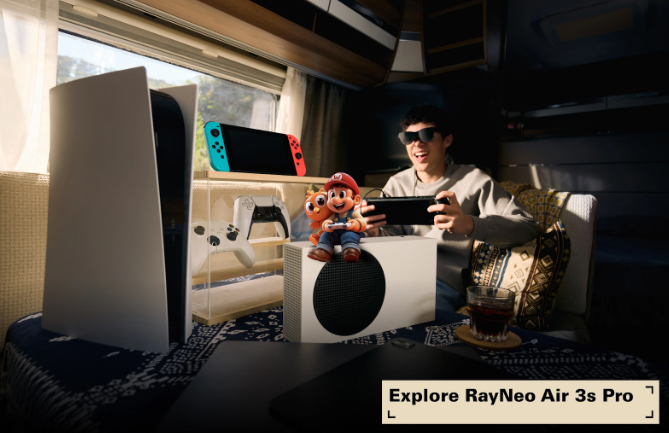
- Gaming Consoles: Acts as a massive portable monitor for the Switch (via JoyDock) or Steam Deck.
- Laptops: Extends your workspace, giving you a second monitor on the go.
For devices without USB-C video output, adapters are available (for example, HDMI-to-glasses solutions for HDMI-only consoles and PCs). However, the direct connection offered by these RayNeo Air 3s Pro AR Glasses is the most seamless experience.
Real-World Travel Scenarios
How do these smart glasses actually perform in the wild? I took them on a trip to test their versatility across different environments.
The most obvious use case is the airplane. The RayNeo Air 3s Pro AR Glasses completely replace the need for the seat-back screen.
But they also shine in hotel rooms. Instead of struggling with the hotel TV remote and limited channels, I lay in bed and watched a show on a 201-inch ceiling screen.
Where They Excel
- Commuting: Perfect for train rides where space is tight.
- Layovers: Turns a boring wait at the gate into a cinema experience.
- Downtime: Great for private relaxation in a shared Airbnb or hostel.
Even in bright environments, high-frequency dimming plus multi-level brightness control (and, when needed, a clip-on lens shade accessory) helps maintain contrast. The RayNeo Air 3s Pro AR Glasses handle lighting changes well.
How It Stacks Up Against the Competition
The market for smart glasses is heating up. Competitors like XREAL and even the camera-focused Ray-Ban Meta are vying for attention.
However, it is important to distinguish the categories. The Ray-Ban Meta is excellent for social media capture, but it lacks a display. It is not for consuming content.
Compared to other display-focused smart glasses, the RayNeo Air 3s Pro AR Glasses offer a more refined ergonomic profile. The adjustable fit system really does make a difference.
The color accuracy on the RayNeo Air 3s Pro AR Glasses also feels more tuned for cinema. Some competitors tend to oversaturate, but RayNeo aims for natural tones.
Ultimately, if your priority is media consumption and gaming, optical AR glasses are superior to audio-only smart glasses.
The Verdict: Is It Worth the Space?
After logging thousands of miles with this gear, the answer is a resounding yes. The trade-off between weight and utility is heavily in its favor.
The RayNeo Air 3s Pro AR Glasses take up less space than a sunglasses case. Yet, they provide an experience superior to a 65-inch TV.
For the modern traveler, minimizing bulk while maximizing experience is the ultimate goal. These smart glasses hit that sweet spot perfectly.
We are no longer waiting for the future of travel entertainment. It is already here, and it fits in your pocket.
If you want to upgrade your travel kit, look into the current generation of smart glasses. Your neck (and your boredom) will thank you.