



If you need clips from scripts, concepts, or product benefits, use the AI Video Generator as the main workflow. If you already have approved product images and want motion variations for testing, use Image To Video to generate fast, consistent creative.
1) The core problem in ads: speed vs. consistency
Ad teams typically face a trade-off:
- – Fast variants often look inconsistent, off-brand, or noisy.
- – High-quality production is consistent but slow and expensive.
VideoAny’s “video-first studio” framing suggests it’s built to reduce that trade-off by keeping video, image, and audio generation inside a single workflow where assets can be reused.
2) Start with a modular structure
A reliable 15–30 second structure can be built from blocks:
- Hook (0–2s): strong visual + one benefit line
- Problem (2–6s): relatable scenario
- Solution (6–16s): product feature in action
- Proof (16–22s): before/after, rating, claim, or demonstration
- CTA (22–30s): “Shop now,” “Get the deal,” “Learn more”
Generate each block separately. It’s easier to control the output and easier to replace just the part that underperforms.
3) Use Image To Video for your highest-leverage variants
The highest leverage in performance marketing is usually the first 1–3 seconds. A static product hero shot can become a premium-looking hook with gentle motion:
- – Slow push-in to add immediacy
- – Soft lighting movement to highlight texture
- – Subtle particles/bokeh to signal “high quality”
From one approved image you can create multiple hooks that stay on-brand. Then swap hook variants while keeping the rest of the ad stable, so your test isolates what matters.
4) Build a 3×3 variation matrix (simple, effective)
A low-effort way to scale variants is a 3×3 matrix:
- – Three pacing options: fast, medium, slow
- – Three angles: price/value, feature/benefit, scenario/use-case
That gives nine variants that are meaningfully different but still controlled. With a consistent visual template and prompt structure, you can generate these quickly and let data pick the winners.
5) Save prompts as templates (your real asset is the system)
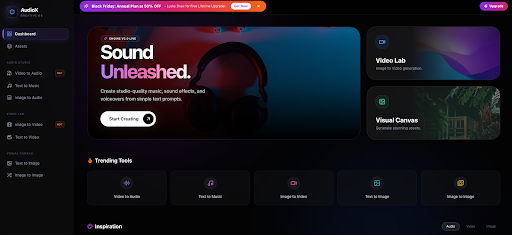
The Home copy emphasizes Assets, Prompts, History, and Credits. That implies the product wants you to work in a repeatable, account-level process. For ads, that means:
- – Save “winning prompt blocks” (camera, style, constraints) as templates.
- – Keep only one variable changing per test (hook motion, headline, or background vibe).
- – Reuse your best-performing visual style across campaigns to build brand recognition.
In practice, this turns your creative process into a system: you’re not reinventing prompts every launch, you’re reusing a proven recipe with new product details.
6) Where the “all-in-one” story actually helps
Landing-page messaging groups AI Video, AI Image, and AI Audio. For ad production, the benefit is less handoff:
- – Generate visuals that match your brand style.
- – Generate motion clips from those visuals.
- – Generate supporting audio elements (music, SFX, voice) without leaving the workflow.
Even if you still do final assembly in an editor, having assets originate from one place reduces mismatch in style and timing.
6.1) Turn a creative brief into a prompt checklist
When teams struggle with consistency, it’s often because the brief never becomes a usable prompt. Convert your brief into a checklist you can reuse:
- – Audience: who is this for?
- – Single promise: what’s the one benefit you want remembered?
- – Visual style: clean studio, lifestyle, premium, playful, etc.
- – Camera language: stable, slow push-in, quick cuts, handheld energy
- – Compliance constraints: no exaggerated claims, approved wording only
Then treat the checklist as the “fixed block” of the prompt and swap only the product details.
6.2) Name and version your assets like a system
The Home experience emphasizes assets and history. For ad work, adopt a simple naming scheme:
`campaign_offer_angle_pacing_v01`
This makes it easy to trace what changed and to reproduce winners when results come back from paid media.
6.3) Keep claims and visuals compliant
Even great creative can be rejected or underperform if it violates platform or brand rules. Before generating at scale, decide what language is approved (exact discount wording, results claims, testimonial phrasing). Then bake that into your prompt template so you don’t “accidentally improvise” in production. A simple discipline—approved copy only, no exaggerated “before/after,” and clear disclaimers when needed—keeps your iteration loop fast because you’re not reworking assets after review.
7) A practical starting path
- Create one hero image set (product + background variations).
- Use Image To Video to generate 3 hook motions.
- Use AI Video Generator to generate 2–3 “solution” blocks from your product story.
- Assemble 6–15 second versions first, then expand to 30 seconds if needed.
- Track results and promote the best blocks into templates.
That’s how you scale ad creative without drowning in chaos: keep the structure modular, keep the motion subtle, and treat prompts as reusable production assets.
8) Budget with credits like production time
Because generation is metered (credits) and plans affect speed/quality, treat credits like production budgeting:
- – Allocate a fixed “testing budget” for hooks (high leverage).
- – Allocate a smaller budget for mid-funnel shots (often stable).
- – Reuse your best blocks instead of regenerating everything each week.
This keeps creative velocity high while controlling costs.
9) Close the loop: turn performance data into prompt updates
Once ads are live, the goal is not “make more random variants,” but “learn what changed outcomes.” A lightweight loop looks like this:
- Identify the weak block (hook vs. mid section vs. CTA).
- Regenerate only that block with one variable changed.
- Keep the winning blocks fixed and promote them to your template library.
Over time, your best prompts become a playbook: a set of proven camera moves, stable motion constraints, and visual styles that consistently perform for your brand. That’s when the AI Video Generator and Image To Video stop being tools and start being a scalable creative system.
10) Add a fast QA step so scale doesn’t create chaos
Before you export a batch of variants, do a quick review pass:
- – Brand: correct colors, logo placement, and approved messaging
- – Readability: text large enough for mobile, high contrast
- – Motion: no distracting warps, stable product edges
- – Compliance: no unapproved claims, no misleading “before/after”
This takes minutes, but it prevents the most common outcome of scaling: generating lots of unusable creative. The goal is not maximum volume—it’s maximum usable volume.