



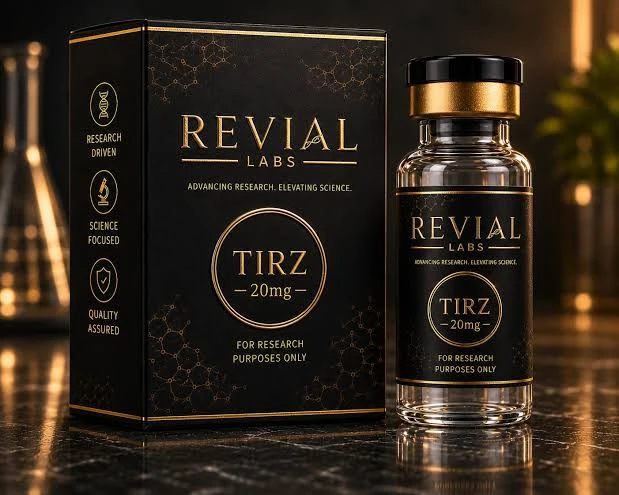
Few scientific names have crossed into everyday conversation as quickly as tirzepatide. A few years ago it was a code number in pharmaceutical pipelines; today it is one of the most searched peptide terms in the UK. That public attention has had a knock-on effect on the research world, where demand for research-grade tirzepatide has grown sharply and so has confusion about what researchers are actually buying.
What tirzepatide is
Tirzepatide is a synthetic peptide of 39 amino acids developed by Eli Lilly. It was the first molecule designed to activate two incretin hormone receptors at once: GIP, which is involved in insulin secretion and fat tissue metabolism, and GLP-1, which influences insulin release, gastric emptying and appetite signalling. A fatty acid chain attached to the molecule binds to albumin in the blood, extending its half-life to the point where weekly administration is possible in clinical settings.
That dual mechanism made tirzepatide one of the most studied compounds in metabolic science and the benchmark against which newer molecules, such as the triple agonist retatrutide, are now compared.
Medicine versus research compound
The biggest source of confusion in the UK is the difference between the medicine and the research compound. Tirzepatide is licensed in the UK as Mounjaro, a prescription-only medicine supplied in pre-filled pens through pharmacies. Research-grade tirzepatide is something else entirely: a freeze-dried powder sold in sealed vials by specialist suppliers, strictly for in vitro laboratory research.
The two are not interchangeable, and responsible research suppliers are explicit about it. They sell vials rather than ready-to-use pens, make no health or weight-loss claims, and require customers to agree to research-use-only terms. Anyone looking for treatment should speak to a doctor or pharmacist, not a research supplier.
Powder or pen?
A trend that worries many in the research community is the rise of pre-mixed tirzepatide pens sold online. Peptides are far more stable as freeze-dried powder than in solution. Once dissolved, they begin to degrade, a process accelerated by heat, light and agitation. A pen that has sat in a warm parcel for days is unlikely to contain what its label says.
For laboratory work, the standard approach remains the lyophilised vial. The powder is stored refrigerated at 2 to 8°C and reconstituted with bacteriostatic water only when needed, after which it is kept cold and used within about four weeks.
How UK researchers are choosing suppliers
With dozens of UK websites now selling research-grade tirzepatide, quality varies widely. Experienced buyers have converged on a few non-negotiables. An independent Certificate of Analysis from a third-party laboratory, not a document produced by the manufacturer. A batch number that matches the certificate. HPLC purity of 98% or higher with mass spectrometry confirming identity. A traceable UK company with a Companies House registration. And stock held in the UK, avoiding customs delays and uncontrolled temperatures.
Price is a factor too, and the cheapest offer is rarely the best one. UK supplier Revial Labs, for example, sells research-grade tirzepatide vials in the UK at £54.99 for 20mg and £74.99 for 30mg, with batch certificates and next-day tracked dispatch. Its free Tirzepatide UK guide sets out the regulatory position, the difference between research-grade product and Mounjaro, and a supplier checklist in more detail.
A maturing market
The research-peptide sector in the UK is growing up. Buyers are better informed, regulators are paying closer attention, and the suppliers gaining ground are those that treat independent testing and clear research-use positioning as the cost of doing business. For tirzepatide in particular, where public interest is so high, that transparency matters more than ever.
Research compounds discussed in this article are supplied strictly for laboratory research use and are not for human or veterinary use.