



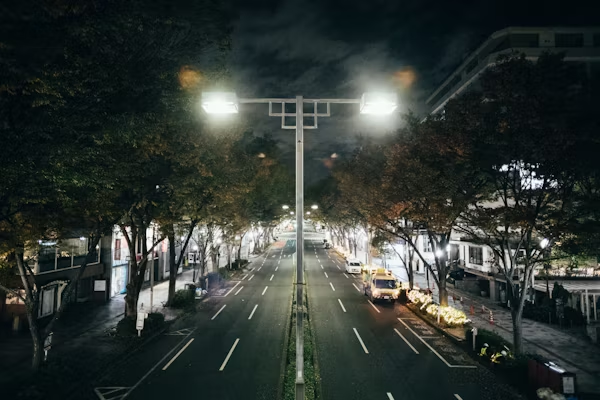
Local governments are tasked with improving services within the view of sustainability, costs, and efficiency. One of the bigger changes is replacing old street lights with LED lights. The most significant savings from LED street lighting is the added safety on the roads, along with improved ecological surroundings. This article discusses the main benefits for B2B customers. They include local government authorities, civil engineers, and construction firms who aim to optimize their proposals for street lighting.
Before discussing the benefits of LED street lights, it is important to explain the term “down light.” This is a type fixture which is attached to a ceiling or pole and emits light only to the bottom. In street lighting, down lights aim at improving lighting for roads, sidewalks and parking areas, which increases safety for the users.
What Is A Down Light?
Down light technology is very useful for street lighting systems. Besides this, adding down lights in LED street lights provides the necessary control for balancing lightspill on public streets. Light pollution more than the necessary amount allocated to street lights is kept in reasonable balance.
Energy Efficiency And Cost Savings
With the advent of led street light manufacturers, it will be useful now to What is a Down Light? the other advantages that they possess. In comparison to the traditional High-Pressure Sodium and Incandescent Bulb street lights, LED street lights use up to 80% less energy. This is a positive sign for me as a street light manufacturer.
Thanks to less maintenance and lowering energy costs, the companies that install street lights and other infrastructure will gain a lot. To provide adequate street lighting for a very long time, this will be the major operational investment.### Longevity and Durability
The durability of LED street lights is one of their most outstanding features. LED Street lights are said to last about 25 years LED Street Lights while old street lights need replacements every few years. The LED Street Light’s lifespan is a marketed improvement and spares the heavy maintenance costs public infrastructure operators need.
LED Street Lights are more rugged and able to withstand other environmental issues without compromising on brightness. Snow, rain and even ice do not affect streets lit by LED Street Lights. They can still perform their primary function without much servicing and repair. This directly improves public safety.
The road managing firms do not need to make maintenance visits, meaning tiers disruptions are not a concern anymore. The chances of road accidents are also mitigated substantially due to the absence of heavy traffic.
Improved Safety and Visibility
Street LED lights can serve safety precaution purposes. Bad street lights that lack the ability to focus can make accidents more prone. Pedestrians along the street can also lose visibility. This is centered more on the issue of how LED street lighting solves the issues of poor lighting and focus to create a balance in brightness.
Compared to outdated orange street lights, LED lights are cleaner, brighter, and more pleasing to the eye. Motorists are able to spot pedestrians and cyclists easier, making the roads significantly safer. In addition, the down light distribution focus of street fixtures equitably reduces glare, light spill, and light pollution. This way, the light remains within the parameters of the illuminated zones.
It is obvious to urban planners and infrastructure developers how greatly street LED lights improve public safety. With visibility and reduced accident opportunities, public areas are made far more safer.
Environmental Benefits and Sustainability
Switching from non LED to LED street lights is more favourable to the environment. Older generation street lights contain mercury, and are bad for both the environment and surrounding population. LED street lights have no mercury, thus eliminating these issues. In addition, traditional lights are more readily available than LEDs, sparking a higher carbon output.
Municipal governments are alleviated from meeting their energy reduction targets. As energy systems improve, needing street light use can decline, thus light pollution can be reduced.
Implementasi Teknologi Canggih
As the population in cities increases, the relevance of digitizing public works increases as well. An example is the implementation of LED street lights, which can easily be incorporated into a city’s existing infrastructure supported by smart city technologies.
Municipalities find the role of the LEDs as street lamps as an opportunity to install sensors and controllers, which enable the remote management and monitoring of the lamps. Electronic devices that assess and help in resolving issues regarding the overall LED performance in real time ensure that the lamps work in an optimal manner. For instance, the system is able to detect and provide solutions when a failure has occurred in a lamp, or when there’s a need for additional illumination in certain regions.
Also, smart street lamps have the capability to autonomously adjust their illumination depending on the volume of traffic flow. During peak hours when there is heavy traffic, the system LED lights brighten, saving on costs associated with energy in the dimmed state. The system returns to the bright state when traffic increases, and when moving pedestrians are detected. This demonstrates energy use in practice. Public safety is also enhanced through the system.
Last, the addition of smart lighting features into LED street lamps is becoming commonplace. This is part of the broader smart city strategies focused on enhancing the sustainability and efficiency of urban systems.
Alongside several benefits, the upgrading of street lights to LEDs have also proven to drastically save energy, money, and improve the safety and advance of the smart technology used in the lights. In addition, it helps the environment. Municipal services, planners, and any other B2…B companies will find value in LED street lights. This will be a positive outcome decision to go with. The lights will also improve energy use and cut down on the expenses used in urban settings. Safety and urban efficiency will also improve thanks to sustainability.
Business and upgrade managers also understand how street lights in LED technology are also a great investment for the future and the present.