



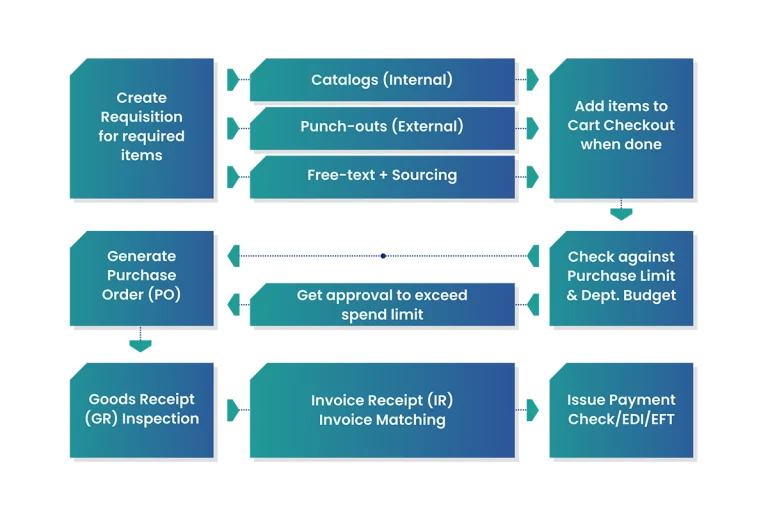
The strategic evolution of procurement can be used to increase the business value. The combination of a procurement system with purchase to pay software is changing the present scenario of the manual procurement process.
Modern businesses are increasingly implementing this integrated technology to create a unified, intelligent framework that improves efficiency, governance, cost control, and strategic insight. The modern procurement system needs quick and efficient outcomes, and it is achievable with the help of purchase to pay software combination.
Dive through this write-up to explore the business value of this integration and how it is changing the business value.
Understanding the Procurement System and Purchase to Pay Software
Procurement System
A procurement system manages the procedures involved in obtaining products and services.
- Requisitioning (making requests for products or services)
- Purchasing and choosing suppliers
- Onboarding and management of the supplier
- Management of a contract
- Management of categories and spending
The procurement system is the strategic way to find the best suppliers, negotiate terms, and maintain supplier relationships throughout the lifecycle.
Purchase to Pay Software
The transactional aspect of procurement is managed by purchase to pay software, which includes:
- Creation of a purchase order (PO)
- Matching invoices and goods receipts
- Processing and approving invoices
- Execution of payments
- Invest in analytics
P2P systems link purchasing to accounts payable by automating financial and operational procurement processes.
Why Integration Matters?
P2P software and procurement systems are used to function independently. Inefficiencies resulted from this, including fragmented data, manual handoffs, holes in compliance, and restricted visibility. On various days, the value is found in combining multiple technologies into a single, linked platform that allows for strategic control, operational effectiveness, and end-to-end procurement intelligence.
Key Business Benefits of Combining a Procurement System with P2P Software
- Unified End-to-End Process Visibility
The real-time insights throughout the whole procurement lifecycle are one of the most obvious commercial advantages of an integrated P2P and procurement system. Organizations benefit when sourcing, contracts, purchase orders, invoicing, and payment data are stored on the same platform.
- Complete spend visibility and the removal of blind spots
- Dashboards for commitments, liabilities, and budgets in real time
- Analytics broken down by supplier, category, business unit, or location.
- Precise projections for budgeting and cash flow
This insight enhances decision-making, fortifies compliance, and provides current purchase data to help with financial planning.
- Better Compliance and Risk Management
- Enforcement of Contract Compliance Automatically
Contract leakage (purchases made outside of contracts) can be decreased by using systems to verify purchases against agreed-upon terms and prices.
- The Construction of Policy Adherence
Unauthorized orders can be prevented by enforcing procurement standards at the point of request, such as approval thresholds, delegated authorities, and segregation of roles.
- Operational Efficiency and Cost Reduction
Disconnected systems and manual workflows are costly. Automation is fueled by integration everywhere:
- Repetitive data entry is eliminated via automated data capture.
- Consequently, companies accomplish:
- Quicker cycles of purchases
- Reduced operating expenses
- decreased rates of errors
- Decreased administrative workload
- Cost Savings Through Better Spend Management
One of the main goals of procurement transformation is spend management. An integrated P2P and procurement solution:
- Minimizes off-contract or maverick spending, which can reduce savings.
- Aids in finding chances for bulk discounts and supplier consolidation.
- Makes it possible to analyze category spending for strategic sourcing choices.
- Improved Cash Flow and Supplier Relations
- Integration improves financial control in a number of ways.
- Conflicts and late payments are decreased when POs, receipts, and invoices are accurately matched.
- Cash planning is improved when payment commitments are more clearly visible.
- When appropriate, automated early-payment discount management aids in capturing savings.
- Processing invoices more quickly increases supplier satisfaction.
- Stronger Supplier Performance and Risk Monitoring
One critical aspect of procurement value is supplier performance. Procurement teams can monitor delivery performance in relation to contract terms thanks to integrated platforms. Proactive risk mitigation and supplier development initiatives are made possible by this capability, which converts supplier data into actionable intelligence.
- Scalability for Digital Transformation
Systems that are scalable are essential for businesses on a growth trajectory. A platform that combines P2P with procurement offers a basis for:
- Standardization of enterprise-wide processes
- Visibility across regions and entities
- Local flexibility combined with centralized governance
- Integration with finance and ERP systems
Without the usual system fragmentation found in older setups, this scalability facilitates multi-entity operations and quick business change.
How Modern Integrated Procurement + P2P Platforms Work?
It is helpful to see how integration truly works in practice in order to properly comprehend the commercial value.
- Architecture for Shared Data
Modern systems employ a shared data paradigm in place of distinct databases, where supplier records are centralized.
- Purchase regulations are informed by contract terms.
- Spend data provides real-time analytics.
- Financial and budgetary data smoothly sync
- This shared architecture eliminates reconciliation gaps and expensive system handoffs.
- Automation of Intelligent Workflow
- Intelligent automation is brought about by integration:
- Requisitions automatically check against the terms of the contract.
- Workflows use spend thresholds to determine their dynamic routing.
- Approvals are automatically monitored and recorded.
- Exceptions are noted for examination.
- This lessens the need for manual intervention without compromising control.
- Embedded Analytics and Reporting
Users obtain dashboards and reports that are integrated within the platform instead of exporting data for offline analysis:
- Invest in heatmaps
- Risk scores for suppliers
- Trends in budget utilization
- Alerts for compliance
- Leaders can act with confidence since these insights are readily available.
Emerging Technologies Amplifying Value
These days, integrated platforms are more than simply tools for transactional automation; they also include new technologies that add even more value. AI enhances:
- Classifying spending and identifying anomalies
- Demand forecasting using predictive analytics
- Risk scoring for suppliers
- Automated exception handling and matching
AI can reduce surprises and enhance planning by transforming large amounts of procurement data into strategic insights.
- RPA, or robotic process automation
- Procedural automation with RPA layers:
- Entering data from different formats
- Automated alerts
- Workflow support for exceptions
RPA increases P2P efficiency without taking the place of people, allowing teams to concentrate on strategic and exceptional work. Natural Language Processing (NLP) improves:
- Analysis of contracts
- Communication with suppliers
- Clause and pricing data extraction
- This reduces manual review and accelerates compliance verification.
The incorporation of these technologies turns integrated procurement/P2P platforms into intelligent, adaptive systems that support both operational and strategic objectives.
Conclusion
Strong business benefits that span operational effectiveness, financial performance, compliance, risk reduction, and strategic insight are produced by integrating a procurement system with purchase to pay software.
If your business is looking for a website that can help you through the procurement system, explore Procol’s purchase to pay solutions that can enable this transformation in your organization.