



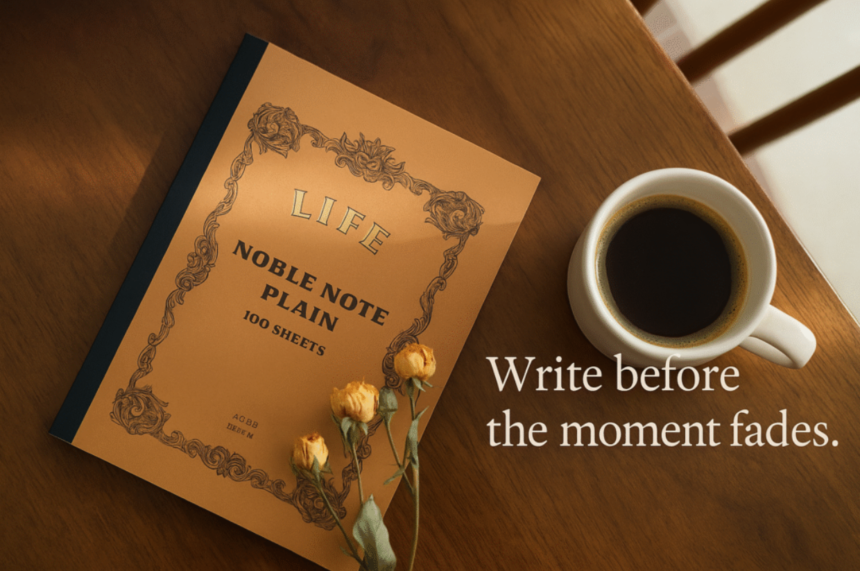
Ideas don’t wait for the “right moment.”
They show up in fragments—while you’re waiting for your coffee, halfway through a commute, or walking between meetings.
And unless you catch them quickly, they dissolve just as fast.
This is where small notebooks prove their worth.
Not because they help you write more, but because they help you write sooner—before a thought slips through the cracks.
A6 and B6 notebooks, in particular, strike a balance between portability and usability that phones and full-size journals simply can’t match.
This article isn’t about selling stationery.
It’s about understanding why small notebooks quietly become the most reliable thinking tools for people who juggle ideas throughout the day.
Why small notebooks still matter
We like to believe our phones can handle everything.
And technically, they can.
But writing on a phone is rarely about the idea—it’s about navigating a device designed to steal your attention.
A small notebook does the opposite.
It clears mental noise
Thoughts pile up when they stay in your head.
Even writing down one line—“email Anna,” “new concept for project,” “don’t forget this”—immediately reduces pressure.
Paper has a way of grounding things that screens don’t.
It removes friction
A notebook doesn’t require tapping through apps or dodging notifications.
It’s always ready.
That lack of friction makes it easier to form a habit of capturing ideas in real time.
It makes small moments useful
Most of us don’t need an hour to think—we need thirty uninterrupted seconds.
A6 and B6 notebooks turn those scraps of time into productive anchors.
Small notebooks matter not because they’re romantic,
but because they lower the psychological threshold for writing.
A6 vs. B6: the small difference that shapes your habits
At first glance, A6 and B6 notebooks look almost identical.
But in daily use, their size difference quietly shapes how each one fits your thinking rhythm and the way ideas appear throughout your day.
A6 notebooks: fast thoughts, fast capture
If your ideas tend to appear while you’re moving, the A6 format is built for that pace. The Midori MD Notebook A6 is one of the most popular choices for quick thinkers, commuters, and anyone who needs a notebook that never slows them down.
It slips easily into a pocket or jacket, making it the kind of notebook you actually carry—not the kind you leave at home because it’s heavy or bulky.
A6 shines when you need to write something quickly: mid-walk, in line, between tasks, or the moment a useful phrase crosses your mind.
You open it, write a line, close it, and keep going.
B6 notebooks: thoughts that need a little more room
If A6 is a sprint, B6 is a comfortable jog—still compact, but with enough space for fuller sentences and clearer structure. People who enjoy slower, more reflective writing often prefer the Life Noble Note B6, known for its balanced, steady-feeling paper that encourages longer entries without feeling cramped.
B6 remains portable, but the extra breathing room makes it ideal for outlining tomorrow’s tasks, capturing small diagrams, reading notes, or jotting down a meaningful moment at the end of the day.
How to choose in one simple sentence
- If you think while moving → Choose A6
- If you think when sitting → Choose B6
Most people know instantly which rhythm fits them once they hear it explained this way.
Six moments when small notebooks become surprisingly useful
Once you begin carrying one, you’ll notice yourself reaching for it more than expected.
These are the moments that matter most:
Commutes and waiting lines
Short idle windows—three minutes before the train arrives—are perfect for jotting a plan or noting a reminder.
Walking between places
Movement clears your head.
A notebook helps you save what surfaces.
The 60 seconds before work
Writing “Start with this today” is often enough to break morning inertia.
Travel and wandering
Trips sharpen attention.
A notebook keeps impressions from fading once you’re home.
Emotional spikes
One honest sentence can be more grounding than scrolling your phone.
Reading and learning
Instead of highlighting everything, you capture only what resonates.
B6 especially shines here.
Small notebooks aren’t built for dramatic moments—
they thrive on the ordinary.
Why paper quality silently shapes your habit
Anyone who writes regularly eventually realizes something simple but overlooked:
the feel of the paper changes how often you write.
Good paper disappears—you stop noticing it and fall into the flow.
Bad paper interrupts the process and makes you write less, even if you don’t recognize why.
For slower, reflective writing: steady, balanced paper
When writing is more about processing your thoughts than capturing speed, the paper needs to support longer sessions without distraction.
This is why many reflective writers gravitate toward the Life Noble Note B6—its paper feels calm and balanced, with just enough texture to keep handwriting grounded.
It’s soft enough for extended writing, firm enough to handle pressure, and friendly to most pens, whether you prefer gentle gel ink or a wetter fountain pen.
For people who write to understand themselves—not just to remember tasks—this steady feel makes all the difference.
For quick, responsive writing: smooth, dependable paper
Not everyone writes slowly. Some people jot in bursts—fast strokes, sudden stops, looping ideas.
For that rhythm, a paper like MD Paper excels. It handles quick movements without drag, and slow strokes without smudging.
It adapts to your writing speed rather than dictating it.
This is why A6 notebooks built with MD Paper feel effortless during commutes, brainstorming moments, or sudden flashes of inspiration.
Paper affects habit more than discipline
People often blame themselves for “not being consistent,”
but inconsistency usually isn’t a discipline issue—
it’s a paper issue.
If the paper feels scratchy, too slick, too thin, or prone to bleeding, you naturally avoid writing.
If the paper feels right, you write more—without trying.
A small notebook becomes a habit not because you’re disciplined,
but because you enjoy using it.
A few notebooks worth trying
You don’t need a dozen.
You just need one that fits your daily rhythm.
- Midori MD Notebook A6 — for quick, spontaneous capture
- Life Noble Note B6 — for reflective, fuller writing
- Midori MD A6 (Blank / Grid) — blank for sketchers, grid for structured thinkers
- Midori MD Paper Cover (A6 / B6 Slim) — for people who take their notebook everywhere
- Life Noble B6 (Plain / Ruled / Section) — different page styles for flexible use
A good small notebook is the one you forget you’re carrying
until the moment you need it.
Final thoughts
The value of a small notebook isn’t measured by how much you write.
It’s measured by how easily you start writing. A6 and B6 notebooks don’t ask for perfect pages or neat handwriting.They simply give your thoughts a place to land—before they vanish.
Carry one with you. Not to be more productive, but to remember the small things: the half-formed idea, the line you liked, the moment you don’t want to lose. Most days, one handwritten sentence is enough to make life feel a little clearer,
a little calmer, and a little more your own.

