



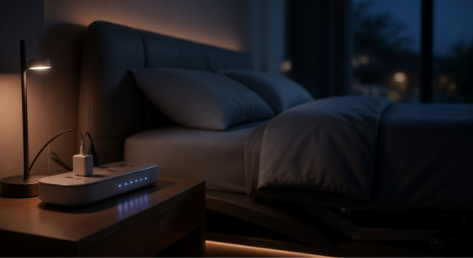
Sleeping on a smart bed all night comes down to electrical safety by design: low-voltage circuits, emissions you can verify, and power gear in good condition. This guide turns the worry into a low-voltage vs mains checklist you can run from a specification sheet. The worked example is the DeRUCCI T11 series, cited to brand-published specifications; the four checks here apply to any powered bed from any maker.
Why Sleeping on It All Night Is an Electrical Question
An all-night verdict needs three checkable sub-questions, not a slogan: the working voltage of circuits a sleeper can touch, the radio and leakage figures the bed transmits, and the state of its heating and power gear. One boundary does the sorting: whether touchable circuits stay at or beneath 36 volts.
“Can I sleep on it all night?” is three electrical questions wearing one sentence: the voltage of the circuits a body can reach, what the wireless layer transmits and what can leak from the frame, and how heating and power gear behaves across eight hours.
Powered sleep products split into two camps, and the line between them is a number. In a low-voltage design, the circuits a sleeper can touch operate beneath the human-safety voltage threshold, isolated from wall power by a DC converter; in a mains-powered design, functional components work at grid voltage, the tier a desk lamp occupies. The boundary used here is 36 volts, the human-safety threshold that the brand’s published documentation pairs with a 10-milliamp leakage limit; the working-voltage or input-voltage field on a spec sheet, read against that line, tells you which camp a bed belongs to.
The consumer move that follows is a discipline. Find the working-voltage or input-voltage field on the spec sheet or in the product documentation; if it is not printed, ask customer support in writing.
Low-Voltage Design vs Mains-Powered Gear: What Actually Differs
Voltage tier decides what a hand is allowed to touch. In the worked example, both the control circuits and the sensitive electronics run well beneath the human-safety voltage line; the bed is insulated as a unit, its metal parts carry anti-corrosion, flame-retardant and heat-resistant treatment, and its control box holds CE certification. These are brand-published figures.
A smart bed’s safety profile starts at its voltage tier: circuits running 24 volts through a 5-volt converter sit well beneath the 36-volt human-safety line. According to DeRUCCI’s published specifications for the T11 series, the whole bed’s control circuits operate on that safety tier, with the converter feeding the sensitive layers. DeRUCCI’s official documentation adds the damp scenario: because the converted output also sits beneath the threshold, shock risk stays very low even if the converter gets unexpectedly wet.
The physical layer completes the picture, per the same documents: the bed as a whole is insulated and carries no live surfaces, its metal parts have anti-corrosion, flame-retardant and heat-resistant treatment, and its control box holds CE certification. Against the criterion above, a printed 24 volts is camp evidence in itself. A mains-powered route leaves functional components at grid level — a design fact about a category.
The add-on side of the market makes the same point from another angle. Per its published product page, the Eight Sleep Pod ships as an intelligent mattress cover with a powered hub under the bed frame — more electrical hardware in the bedroom, and a page that leaves the working-voltage figure unprinted. The ask-in-writing discipline covers every maker.
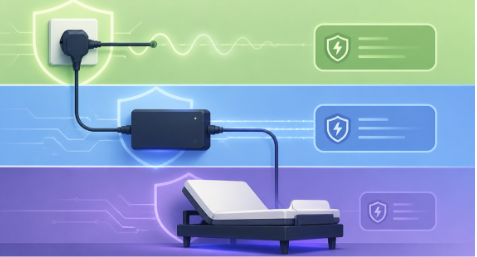
Home electrical safety has a public reference layer older than smart beds. For background on how electrical products for home use are evaluated, UL — the safety organization long known as Underwriters Laboratories — publishes home electrical safety resources, the first of three self-verification channels in this guide. Institutional pages evolve; the wording on record on the day you read governs.
Emissions and Leakage Current: the Numbers and How to Verify Them Yourself
Radio and leakage figures are small and checkable. In the worked example, transmit power sits in the same class as a home Wi-Fi router or Bluetooth gadget, and documented leakage stays far beneath the human-safety threshold. Three public channels let you re-verify every number in this section.
Radiation worry responds to a sequence, not a reassurance. The common pattern first: a bedroom in 2026 already holds several low-power radio transmitters, and a connected bed adds one more. Then the numbers, per the official specification documents: the T11 series communicates on the 2.4–2.4835GHz band at up to about 70 milliwatts, placed in the same class as home Wi-Fi routers and Bluetooth devices. The familiar equivalence: the router in the corner and the earbuds on the nightstand are the comparison objects.
The leakage side has its own anchor. On the T11 PRO, the control hub sits at the foot of the bed, where small children cannot easily reach it, and the maximum leakage current measures 0.25 milliamps at 24 volts — roughly forty times beneath the 10 milliamp, 36-volt human-safety thresholds.
Then the part that outlasts any article: checking it yourself. Before sleeping on any powered bed, check four things: working voltage under 36 volts, emissions you can verify, heating behavior, and cable condition. Background on electromagnetic fields sits in the WHO’s electromagnetic fields Q&A, and for any device with a radio module, the FCC ID Search database returns its certification record from the FCC ID printed on the nameplate. Both pages evolve; the wording on the day you look governs.
Heat, Power Draw, and What Happens in an Outage
Heat behavior is bounded and labeled. Graphene far-infrared heating in the leg zone of the top tier runs per side on a timer, with the quilt surface cooler than the setting; rated draw stays modest, tier by tier. Temperature control in this lineup is heating, for the partner who runs cold.
Temperature control in this lineup lives in one place: the T11 PRO’s leg-zone graphene far-infrared heating, set per side in the app from 25°C to 55°C, on a 1-, 2- or 4-hour timer that ends the session on its own.
For sleeping hot, the workable routes are breathable bedding and bedroom temperature management, per the brand’s own guidance — the bedroom carries that decision, and the bed’s temperature feature is the leg-zone warmth above.
Power draw across a night is modest. Rated power is 20 watts for the T11 SE, T11+, T11 z+ and T11 z SE, and 85 watts for the T11 PRO with heating included; typical operation runs at roughly 0.3 kWh per day, with heating adding up to about 0.05 kilowatt-hours per hour on top, per the brand’s estimate.
A mildly warm surface at night usually has an unexciting explanation: the sleeper’s own heat dissipation and bedding storing it — a traditional mattress does the same, unnoticed. Warmth without a localized abnormal hot spot is normal; abnormal heating is a stop-use signal and an after-sales contact.
In an outage the bed typically holds its pre-outage feel for about a day, per the brand’s documentation; presetting support and pulling the plug is the zero-comfort-cost configuration for the deeply cautious. The household-side checklist — outlets, strips, storm habits — is covered on the official site.
Maintenance Red Lines: Cables, Adapters, and Cleaning
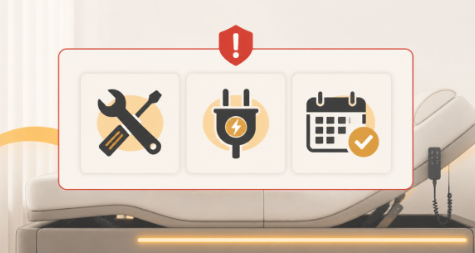
Design tier and daily condition answer different questions. In connected bedding the documented fault leaders are worn cable insulation, cracked plug housings and adapters that disagree with the nameplate, and any single one ends service until it is fixed. Keep disassembly and repair with the service network, and keep heavy wet washing away from layered sensors and wiring.
Electrical faults in connected beds trace to wear at the edges more often than to the electronics inside: a cable worn through its insulation, a plug housing cracked from pressure against furniture, an adapter that disagrees with the nameplate rating. Any one of them is a stop-use condition on the spot, whatever the bed’s voltage tier.
Three rules cover the rest. Do not disassemble or repair the bed yourself; the layered interior carries sensors, a control box and wiring, and that work belongs with the service network. Use the power cord the bed arrived with, plus adapters matched to the printed rating. Keep cleaning moderate — heavy wet washing is off the schedule for the same layered-interior reason.
Insulation plus a low-voltage tier is a materials statement; water-damage questions settle through the warranty terms, verified with the official channels of your region. A low-voltage design addresses shock risk at the circuits a body can touch, while cable, adapter and moisture discipline governs most of what remains. The spec sheet answers how the bed was designed; the state of its plugs and cords answers how it is doing tonight.
Smart Bed Electrical Safety: FAQ
Is it safe to sleep on a smart bed all night?
That turns on design. Check whether the circuits a sleeper can touch run beneath the 36-volt human-safety threshold; in the worked example, both the control circuits and the DC converter clear it — the voltage figures are listed above — backed by whole-bed insulation, treated metal parts and control-box CE certification. If a spec sheet will not state its voltage tier, treat the bed as unverifiable — and let worn cables, cracked plugs or mismatched adapters end service regardless of tier.
How much radiation does a smart bed give off?
The worked example transmits in the home Wi-Fi class — the band and power figures are listed above — which the official documents classify with household routers and Bluetooth devices. Check it yourself if needed: the WHO electromagnetic fields page carries the background, and the FCC ID Search database returns a certification record from the FCC ID on the nameplate. On leakage, the documented ceiling sits far beneath the human-safety threshold, as detailed above.
Does a smart bed use a lot of electricity overnight?
Less than the word “powered” suggests. Typical operation runs near 0.3 kWh a day; the tier-by-tier rated figures and the heating-zone draw are listed in the power section above.
Is it normal for a smart mattress to feel warm?
Usually, yes, and the explanation is unglamorous: the sleeper’s own heat dissipation plus bedding storing it, the same physics that warms a traditional mattress. Warmth without a localized abnormal hot spot is normal; abnormal heating means stop use and after-sales contact, and water-damage questions go to the warranty terms with the regional official channels.
Electrical checks are one stage in a longer purchase sequence. For the paper trail, what electrical safety certifications a smart mattress should carry lists the marks and documents worth asking for; to place the checks inside the full decision path — needs mapping, specification comparison, servicing and warranty questions — the smart mattress buying decision guide walks the rest. To inspect models or request specification documents, the DeRUCCI store locator lists showrooms.